The Associated Press’s News Microformat

The Associated Press (AP) recently announced a semantic markup standard they’d like to see adopted online for news articles – the “hNews Microformat“. The proposed microformat was announced simultaneously with their declaration of a news registry system to facilitate protection and paid licensing arrangements for quoting and using news article material. While the overall announcement and news registry system was widely ridiculed in the blogosphere (in part because of a confusingly inaccurate description which stated that the microformat would serve as a “wrapper” for news articles, and the overall business model and protection scheme seems both naively optimistic and out-of-touch with copyright “fair use” standards and actual technological constraints), but the hNews microformat part itself could potentially gain some traction.

So, if you’re an online marketer of a site which publishes large amounts of articles and news stories, is the hNews microformat worth adopting to improve your online optimizations?
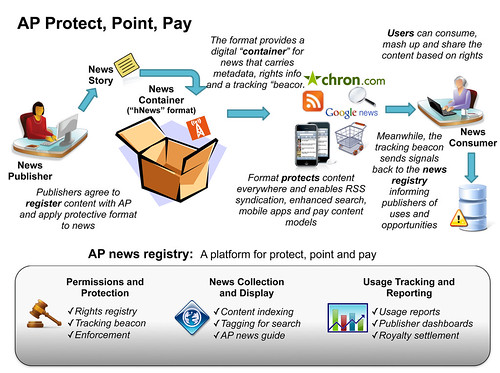
AP Protect, Point & Pay Diagram
(AP's Diagram Illustrating "Protect, Point & Pay" System & hNews Microformat)

I’ve long been a proponent of incorporating microformats within webpages as a component of overall good usability and potentially valuable formatting for search engine optimization purposes. Microformats can provide some additional, enhanced usability for advanced users who are using devices which can read the information and store it for future use, and they can potentially improve search engines’ ability to understand the content within webpages which could lend a marginal increment more SEO value.

Both Yahoo! and Google have been sending signals for the past few years that they consider some of the microformats to be potentially useful as well. They’ve both marked up their own local search results with hCard microformatting for end users’ benefit, and they’re both starting to make use of microformatting to give certain types of data special treatment. In the case of Google, they announced that they’d begin displaying some microformat data with slightly different listing layouts in the search results, a treatment that they’ve dubbed “Rich Snippets”. And, they say they’ll be rolling out more treatments based on microformats in the future.

With this background in mind, it’s not surprising that the AP has jumped on the microformats bandwagon, but it also appears that they’re trying to influence the development of them where news articles are concerned, with a major agenda in mind. They wish to include some sort of webbug in each news story’s markup, so that publishers of the content can be tracked more easily by them – it will be clearer when sites are reprinting news stories, and how frequently those stories are visited and viewed by consumers online.

Other portions of the hNews microformat appear to be more useful from both a search engine viewpoint and publisher site aspect. Labelling of items including keyword tags, headlines, main content, geographic locations and including author’s vcard info all appear to be valuable standards.

(I could really criticize their “geo” tagging of the articles as quite inadequate, though. Merely adding a longitude and latitude to an article seems quite short-sighted, because there needs to be further definition of what is being geotagged. If an article is about multiple locations, it would be ideal to label each geotag to tell what item is being located. Further, it would be ideal to label the article with an assumption of the geographic region that the article should be expected to appeal to. Is it mainly of interest to people within a particular city, state/province, region, nation, or is it of international interest? Still, having some geotag is better than nothing.)

For any marketers out there considering adopting the hNews Microformat standard, I’d advise waiting until the dust settles on this one. Other microformats developed perhaps more objectively, and there’s a lot of distrust and disaffection with the heavy news industry influence that is involved in this proposed standard. Currently, I’m not convinced that it will be widely enough accepted to become valuable for use. While having AP partners all adopting the standard may be sufficient enough to reach a tipping point where many other sites and companies will make use of hNews, Google’s public response to it was unusually cold-sounding.

Blogger/reporter Matthew Goldstein quotes Google’s response on the matter: “Google welcomes all ideas for how publishers and search engines can better communicate about their content. We have had discussions with the Associated Press, as well as other publishers and organizations, about various formats for news. We look forward to continuing the conversation.” While sounding expectably neutral and noncommittal, Google is also stating that this has not been widely-accepted by everyone, even within the news industry itself. This in combination with widespread skepticism within the developer/microformat community and blogosphere signal that hNews may have a very long way to go before it becomes something worthwhile for optimizing articles on publisher sites.

So, for now I advise avoiding this proposed standard, sit back and see how the dust settles. If you’re already syndicating content via RSS and Atom feeds, then you’re already distributing your content in a manner that’s easily absorbable and readable by search engines.


8 Tips for Getting Online News Reporters To Promote You & Your Site

As a brief follow-up piece to the article I wrote this week on Search Engine Land, Three Ways To Optimize Business For Local Search Via Online Newspapers, I thought I’d list a few tips on how to pitch stories to local newspaper reporters in order to get coverage of your business along with the almighty links and reference citations which can help your site and listing rank higher than competitors.

8 Tips for Getting Reporters to Promote Your Business:

  • Issue a press release or “media alert”. Prepare when you pitch a story idea to local news editors and reporters. Reporters and editors are not at all lazy, but they are pulled in many different directions and are presented with multiple story options every day. So, if you want to increase your chances of having your story idea get taken by them, prepare it a bit. Do a brief write-up of the concept and prepare it like a written news release. Write it up in clear, “Who, What, Where, Why, When” format. For the “What” part, explain exactly what your concept is and why it should be considered compelling.
  • Hop on a media feeding-frenzy! Watch the current news and see what’s hot in public perception, and when some bursty bit of news is emerging into public consciousness as The Next Big Thing, be prepared to exploit it for your own advantage. Formulate a story idea linking your business/product to the current hot news item, and issue your media alert so that your local reporters will have a hot story item handed to them on a platter, ready to run with!
  • Be unusual! Run-of-the-mill story ideas are yawners and will cause your story idea to get ignored. Think in terms of attention-grabbing headlines. Can you state in one sentence why a story about your company or product would attract the attention of an average man-on-the-street? Make this your press release headline. Even just a clever turn of phrase about a moderately run-of-mill story concept could be the differentiating factor that gets your story some media coverage.
  • Do your homework. If your story idea involves making some sort of significant claims or is founded on some sort of facts external to your company, help the reporter by finding the information they’d need to check out your claims and verify facts. Provide them with links to independent reports, phone numbers of experts who back you up, and other supportive documentation.
  • Provide free photos. I’ve written previously about how free photos is good for SEO. In this same vein, providing photos that illustrate your press release or story idea for a reporter helps save them time and makes the story that much more compelling if it’s done right. Furthermore, provide an easy-to-use Press Kit on your website with a number of images that help the press and bloggers illustrate stories about you. Press kits should include a few sizes of your company logo, for both print and online, pictures of your company, employees performing typical services, customers having fun at your place of business, and pictures of prominent employees who may be frequently quoted. Be sure to have signed image releases of any recognizable people appearing in these photos, though!
  • Offer to be an expert commentator. Whenever stories come up about your industry, businesses type, or area of expertise, it’d be great if reporters would think of you as an expert they can quote. There are a number of places on the internet where you could register yourself as an expert commentator for particular subject matter, and you can also provide your credentials in advance to various TV news channels, local newspaper offices, radio station, and to local reporters and bloggers.
  • Build rapport with your reporters! Be friendly, accommodating and easy to work with for any reporter who calls you up! Let’s face it – they’re doing you a big favor, and you should be thankful. If you’re fun to work with, they may think of you much more frequently as a person to go to for stories. Send a thank you note after a story about your airs, and even send them a freebie or discount coupon from your business.
  • Manufacture a PR stunt! It may be cheap and, frankly, very blatantly engineered as a self-serving effort to get attention, but if you can arrange it for a “slow news” period, it can work just as well as any meatier news idea. Just be restrained about doing such a thing too often. Use this for slow business seasons and when you may’ve had a long dry spell from any media attention. Do it too often and you’re risk audience fatigue and it will not be as effective.

These tips owe quite a bit to Emmy Award-winning reporter, Jeff Crilley’s book, “Free Publicity.” You can read his book for even more ideas.

Image Search Vital To Rankings

A MediaPost article by Laurie Sullivan reported on some of the comments from reps of search engines Google and Bing at the recent SES conference in San Jose. According to them, consumers rely on images in search results more than previously thought, and, knowing this can help SEO professionals to better optimize sites.

Nadella shows current popular content in Image Search: Michael Phelps
Microsoft sees increasing importance of images to searchers - and their search engine's homepage design reflects this

The representative from Microsoft Bing stated that after regular web search, Image Search was their next most-popular feature. This also reflects the same user behavior that Google and Yahoo! have reported in the past (at least until Google purchased YouTube – before that acquisition, Image Search was Google’s second most popular feature).

With the advent of “blended search” or “Universal Search”, where images and other vertical search content are mixed into the traditional keyword search results listings, the usage picture becomes a bit more blurred. Users are now able to find image content in the regular search results, and they don’t always have to click into the specific image search pages to be finding and clicking through to that content. As such, marketers desiring to dominate keyword search page “real estate” must seriously consider targeting some image content to be able to exploit this channel.

If you’re familiar with me, you’ll know that I was one of the earliest SEO experts to write articles on optimizing images for search, and particularly a pioneer in optimizing images via Flickr and optimizing images through other image sharing services. (See also my Comparison Chart for SEO Value of Image Sharing Sites.) I’ve also spoken numerous times at marketing conferences on the value of Image SEO and how to go about optimizing images for search. It’s safe to say that I’m a proponent of it!

Google is also promoting image content in regards to search presence. At SES, Google’s representative, R.J. Pittman stated, “Images are no longer a ‘nice to have, but a must-have’ piece to promote businesses online.”

Google is also continuing to aggressively develope innovations in their image search engine sophistication. Google is no longer merely focusing upon the contextual text keyword content surrounding images in order to interpret their subject matter, they are now using a number of strategies for actually analyzing the graphic content of images and their relative quality compared with other similar images.

One of the biggest issues that I see facing internet retailer sites, travel portals, and other online commerce sites is the fact that they’re often incorporating thousands of product images supplied by their providers. Those manufacturer or content provider supplied photos are replicated across many competitor websites, and the search engines like Google expend great effort at detecting duplicate content such as this so that they can offer up a variety of images when their users conduct searches (trying to avoid offering up a page of search results where all thumbnails reflect the same identical image).

I know a number of ways around the duplicate content filtering in addition to how to optimize for contemporary image ranking factors. If there’s sufficient interest, I might soon provide a list of tips on how to optimize for these paradigms, so leave a comment below if you’d be interested!

Should You Use .TEL Top Level Domains (TLDs)?

.TEL domainsPeriodically, someone will launch a new, specialized Top Level Domain (“TLD”), claiming it’s the next big thing on the net. As we’ve seen time and again (such as with the .MOBI TLD), most of these efforts are never going to achieve the same level of recognition or adoption as the .COM and .NET standards, and businesses which muck about with them are likely to expend valuable resources resulting in zero ROI.

Such is likely to be the case with the .TEL top level domain which launched in March. .TEL, operated by Telnic Limited, is intended to be a sort of domain-based authoritative location for contact information – a sort of grand new evolution of phone directories, white pages, and yellow pages. When you obtain a .TEL domain, you don’t manage it on the servers of your choice, but instead it will generate a site hosted on the Telnic service. Justin Hayward, Communications Director for Telnic, is quoted as saying:

“We consider .tel to be the first global live contact site directory. Once contact details are populated in a .tel, anyone can type a known .tel address into any browser or use keywords that describe the person or business they want to find. Keywords are free so the more keywords that are used and the more descriptive they are, the easier it is to be discoverable.”

On the surface, this all sounds good, but the first problem I see with it is one of adoption: if people know to look for you, they will not be likely to type in a .TEL domain name — everyone looks for .COM. Even if you specifically tell someone about your .TEL URL, you’ll expend extra time explaining that, yes, .TEL *is* a type of web URL, and even then they’re just as likely to type it in as “something.tel.com”, which is operated by Tokyo Electron company, and not the proper Telnic page URL.

This is the exact same issue with .MOBI, which was intended to be used as an authoritative URL for the mobile-friendly versions of websites. Most people don’t know/understand the protocol, so they won’t be naturally typing it in when out and about with their mobile devices (and, .Mobi has the additional downside of creating one-letter-longer URLs, which make it that much more tiresome for someone on a wireless device to type in).

From a marketing perspective, .TEL domains have additional downsides. You don’t appear to be able to control the UI or look-and-feel of the generated contact pages, and slapping on yet another domain can split the effectiveness of your natural search engine optimization work. Links pointing at that additional URL will dribble away portions of the PageRank you could be sending or keeping for your primary domain.

And, how will search engines treat it? As with many of the lesser top-level-domains, they’re likely to be more mistrustful. I see zero toolbar PageRank values for the top-ranking .TEL pages, though this may be due to the domains only getting launched recently. But, their public statements touting keywords (“…Keywords are free so the more keywords that are used…the easier it is to be discoverable…”) and the fact that domainers seem to be excited by having another channel to potentially exploit makes the TLD concerning in terms of potential search engine performance.

Bucking standards in favor of creating your own proprietary one, and flying in the face of established adoption rates in terms of internet consumer behavior are not a good formula for success.

In a very self-serving blog post by Telnic CTO, Henri Asseily, titled, “Why .tel and not a free hcard microformat?“, they seem to also be taking aim against the increasingly popular hCard Microformat standard in favor of .TEL. What’s funny about this is that this is comparing apples and oranges, and Telnic has deployed example domains (see emma.tel, henri.tel) which provide a vCard at the bottom of the pages.

It’s absolutely stunning to me that they took the trouble to provide vCard off of their contact info pages when they could easily also embed all the vCard information into the page itself, using semantic markup! Meanwhile, his blog is suggesting that using .TEL in some way should be done instead of using hCard! And, I totally fail to see the significance of protecting info he’s referring to with privacy settings — are the .TEL pages a publicly-findable directory of contact info, or not?!? It’s disappointing that they wouldn’t simply incorporate the hCard and thereby gain additional advantage from the special display treatments that Google has begun applying to microformat-enriched pages.

Telnic is partly promoting their service as a way of providing individuals’ and businesses’ contact info on the internet, “even if you don’t have a website”. Ummm… don’t the online white pages and yellow pages already do this?

For companies considering adopting the .TEL for online marketing advantage, you should seriously reconsider. This is not going to become the defacto online standard anytime soon, and expending time playing with this domain is going to take resources away from efforts which are likely to be far more beneficial. At worst, linking to new .TEL domains could also subtract some of your existing PageRank value to little advantage.

The only case in which a .TEL domain could potentially provide advantage is in the case of a project to improve online reputation, if you’re looking for additional webpages to come up in SERPs, helping you to push down some sort of negative content which may be ranking for your brandname. However, there are a lot more social media sites, business profile pages, and additional strategies which you should be employing in that case, and the unproven nature of .TEL sites in organic search rankings relegate use of the new TLD to the bottom of your list of possible online reputation weapons.