
On 10 Sept 2009, Yahoo launched a new PPC Traffic Quality report that will be a real boon to PPC advertisers wanting to track the effectiveness of their campaigns across the Yahoo Search network. Yahoo provides PPC ads along side search results for both Yahoo properties and other sites that show Yahoo search results (called the Yahoo Search Network, or Search Partners). Since Yahoo does not allow advertisers to opt out of their search network, tracking performance is of paramount importance to making the campaigns successful. The new Ad Delivery Report will Continue reading
Monthly Archives: September 2009
Embattled Yellow Pages & SEO

My article on the “Brave New World For Yellow Pages” aired today on Search Engine Land. In it, I describe how Google Trends is showing that each of the major internet yellow pages has taken a sharp dip since the end of last year and early this spring. I diagnosed the cause of this apparent downturn in referred visits from Google as being due to Google’s change to display their local 10-pack in more cases where user queries don’t include geographic modifying terms (they’re incorporating users’ IP address geolocations).
There are many variables involved, so others may easily dispute my diagnosis. However, what is indisputable is that from Google’s perspective, these sites are now getting fewer referral visits.
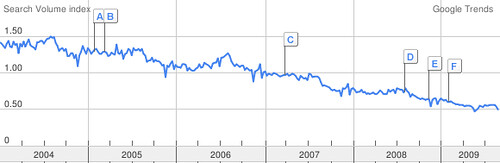
This isn’t a complete surprise. There have been indications for some time that overall trends could go in this direction, and many of us in the yellow pages industry were concerned about search engine incursions into YP territory from the beginning. I’ve previously pointed out another concerning behavioral change shown by Google Trends – fewer and fewer users are searching for “yellow pages” in Google keyword search over time. That trend is still continuing:
John Kelsey recently wrote about how these companies can turn things around, even though he implies their “backs are against the wall”. I agree. From an SEO perspective, it’s nowhere near the end-of-the-line for these companies.
It’s ironic that local search marketing experts all recommend that businesses update and enhance their listings within these websites, in large part for local SEO value. Yet, these sites now are struggling with their own SEO.
Almost uniformly, each of them have a huge amount of trust and PageRank from Google. This SEO goodwill can be employed to turn these trends back around, if that goodwill isn’t squandered.
In the SEL article, I mentioned Yelp’s success over the same period of time, and it hints at one of the elements needed. Good user-experience and an engaging interface can do quite a bit. Also, subtle details can make the difference between a site where people wish to interact and add value versus those where people really don’t wish to hang around.
Various SEO improvements should also be used – improvements to the amount of content on pages, the breadth of information about businesses, and forming that content into signals which effectively “sing” to the search engines. There are quite a few areas neglected by these sites, with little excuse. For instance, as far back as 2006, I recommended employing Microformatting for local SEO value. If all of these sites had been following my recurring recommendations on integrating Microformats, many of them would now be sporting improved display in Google search results, similar to Yelp — when Google rolled out Rich Snippets a few months ago, suddenly Yelp listings were decorated with eye-catching star rating icons, and stats have shown that these treatments likely increase click-through rates considerably. (Insiderpages was the only other one of these sites which I noticed were using the Microformats, and the only other ones which enjoyed the Rich Snippets icon treatment in Google SERPs.)
Microformats are only the tip of the iceberg for most of these sites. Basic building-blocks of SEO are lacking in many cases. Search engine friendly infrastructure such as bot-friendly URLs, robust linking hierarchies, good page titles, descriptive metadata, and stable URLs which don’t continuously appear/disappear are some of the items which these companies struggle to have.
I believe these companies can turn the trend back around and increase their natural search referral traffic dramatically. But, are they willing to make the changes necessary to do so? It will almost certainly require them to pull out all the stops in taking their SEO games to the next level.
Hear Us Speak At SMX East!

- 10/5: SMX Boot Camp: Keyword Research Tools & Techniques – Christine Churchill
- 10/5: Local & Mobile Search: Maps, Maps, Maps! – Chris Silver Smith
- 10/6: Pumping Up YouTube – Christine Churchill (moderating the session)
- 10/7: Social Media, Search & Reputation Management – Chris Silver Smith
Don’t miss this opportunity to hear a couple of us from Key Relevance, speaking in person! Attending SMX can provide companies with significant benefits in terms of developing search marketing savviness. More than 150 of the world’s most knowledgable internet and search engine marketers will present at SMX East. Register now!
Let us know if you’ll be attending, and/or drop by one of our sessions to say hello!