By Jim Gilbert
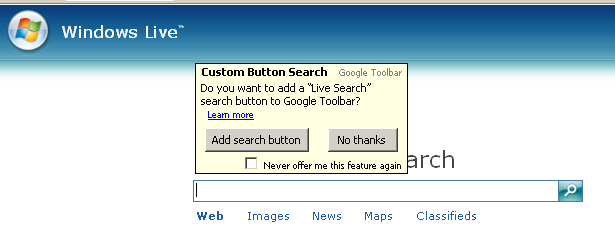
If you are a Firefox user you may be able to visit Microsoft’s Live.com and find the following pop-up when you click in the search box:

By Jim Gilbert
If you are a Firefox user you may be able to visit Microsoft’s Live.com and find the following pop-up when you click in the search box:
Pew Center study finds that most Hispanic Americans "remain largely disconnected from the Internet."
By Larisa Thomason
Hispanic Americans are the fastest growing minority group in the United States, but they don’t access the Internet in numbers equal to their size. A joint study titled “Latinos Online” by the Pew Hispanic Center and the Pew Internet and American Life Project found that only 56% of Latinos regularly use the Internet. Comparatively, 71% of non-Hispanic white Americans are regular users.
The study also found that length of residence, education, and language largely determines Internet use among Latinos. For example, the summary section notes the following statistics:
- 78% of Latinos who are English-dominant and 76% of bilingual Latinos use the Internet, compared with 32% of Spanish-dominant Hispanic adults.
- 80% of second-generation Latinos, the sons and daughters of immigrants, go online, as do 71% of third-generation Latinos.
- 89% of Latinos who have a college degree, 70% of Latinos who completed high school, and 31% of Latinos who did not complete high school go online.
So, does this mean that Web site owners who spent time and money creating good, usable Spanish language pages and Hispanic-oriented content to their Web sites have wasted the effort? No.
They should probably congratulate themselves for being ahead of the curve. The Hispanic population is growing rapidly, which means an increase in absolute numbers of users – even if the percentage remains the same.
However, the statistics cited in the Pew survey lead me to believe that the current 56% overall total should rise sharply in the next decade (or sooner). If for no other reason than the population of second and third-generation Latino Americans will increase as the current generation raises families.
As a relatively youthful, fast-growing segment of the population, Hispanic Americans are an attractive demographic segment. As you develop new content for your Web site, maybe it’s time to consider appealing to this market.
That doesn’t mean you have to start developing a complete Spanish-language mirror of your site. Instead, review culturally relevant ways you can appeal to the market. Maybe that does mean offering some Spanish-language pages, acknowledging more diverse holidays, or modifying your merchandise offerings. It depends on your target audience and their preferences.
A key component of usability is readability and, by extension, the ability of your audience to understand the content offered. Make sure that you and your target market (literally) speak the same language!
IBM set to unveil a new, open source Web accessibility tool.
At next week’s 2007 Technology and Persons With Disabilities Conference, IBM plans to formally present a new tool for Web browsers that will help people with visual disabilities access multimedia content on the Web.
"Just because someone is blind, it doesn’t mean they shouldn’t be enjoying YouTube or MySpace or anything else like that," said Frances West, director of the Worldwide Accessibility Center for IBM.
This could be a giant step forward in Web accessibility. You’d think that podcasting, video files, audio files, etc. would be ideal ways for people with visual disabilities to access content – and they are. The problem users have isn’t with the multimedia files themselves; it’s how those files are embedded in Web sites.
As today’s article in ZdnetIndia notes:
When streaming audio or video requires users to click a Play button using their mouse, there is usually no keystroke alternative, and the controls are randomly placed on the screen; If they can’t press Play, they can’t experience the multimedia.
In cases where the audio or video streams automatically once a page loads, the Web page’s audio often interferes with a user’s audio aids.
IBM’s tool will provide predefined shortcut keys that help users control how and when multimedia files play.
Although IBM promotes the tool as something being done for the good of society, they’re also keeping an eye on the huge population of aging baby boomers who have recently donned reading glasses and hearing aids.
And, as someone who holds her breath during every annual eye exam (Will the doctor utter the dreaded bifocal word this time?), I’m happy they’re making the effort.
I’ll be joining my good friends Jill Whalen, Lee Odden, Matt Bailey, Scottie Claiborne and Karon Thackston next week in the Twin Cities for another High Rankings Search Engine Marketing Seminar.
If you’ve never been to one of Jill’s seminars, they are an informal two day immersion into the world of search marketing. Another good friend Kim Krause Berg has joined us at several seminars and wrote about her experience in her article What a High Rankings Search Engine Marketing Seminar is Really Like
.
To register or to get more information on the Minneapolis seminar, go here. Hope to see you there.
– Christine Churchill
Few leading Web sites worldwide meet basic accessibility guidelines.
Larisa Thomason
The United Nations recently commissioned a Web accessibility study that validated the anecdotal evidence people with disabilities have offered for years. Most Web sites have accessibility problems. In fact, many sites don’t even fulfill the most basic accessibility requirement: ALT text on images.
The UN study audited the accessibility of 100 leading Web sites from 20 countries. (Request an executive summary of the report.) The results were startling to many – but not to people with visual or physical problems. For years, they’ve been frustrated by inaccessible sites.
Their aggravation is understandable once you look at some of the results.
Ok. So some of the other findings – like using JavaScript for important functionalities – may be harder to bring into compliance. But ALT text descriptions? Header tags? Descriptive link text? Readability?
What were the designers thinking when they put these sites together? This is basic design that affects every user and costs sites money in lost sales and customer goodwill. If people can’t access your information and use your shopping cart, they sure won’t buy your products.
And, as AOL found out, they may just sue you for good measure. In 1999, the National Federation of the Blind sued AOL because, among other problems, the company’s software was incompatible with screen reader technology. The NFB withdrew the suit after AOL agreed to make changes. In October 2006, the NFB sued Target, citing several issues including the fact that the site requires the use of a mouse to make purchases.
On December 3, 2006, the UN observed an “International Day of Disabled Persons,” and described the importance of accessible technology, noting that:
Persons with disabilities are at a considerable disadvantage by not being able to access information technologies. For instance, as education becomes increasingly dependent on information technologies, not being able to access the Internet for example limits the learning potential of persons with disabilities.
Whether or not the United Nations effort actually has any benefit remains to be seen. But at least it may help focus attention on the problem – and enlighten recalcitrant designers about just how easy it is to meet basic accessibility requirements.
Google recently posted on their Adwords blog about their overall numbers for invalid clicks and posted about a few upcoming features as well.
After reading this I can say that the .02% click fraud rate may not usually be what you can expect when looking at your particular vertical. Below I will cover a few topics of interest from their post.
The Invalid Clicks Number Provided in AdWords Reporting
The Invalid clicks report – is a number (with no supportive data provided) of the amount of invalid clicks (click fraud included) that Google says they have filtered out available in AdWords reporting.
Even if this number were accurate it would only represent the amount of invalid clicks that Google is able to detect. If you have done any reading on the technology in use to wage fraud then you know it doesn’t look good. I wont divulge these practices here in the hopes of not further spreading them.
One of my favorite statements from the blog post is (and that Yahoo threw out in a SES click fraud panel I was on):
“Advertisers have always been able to compare their log data with their AdWords charges to calculate an estimate of the number of invalid clicks in their own account.”
How?
1) No two analytics programs ever match even when having the same source data.
2) If they did match, the best I would know is how much more or less I am off from the total amount of clicks reported by AdWords. The AdWords system, like every system is not perfect and doesn’t always count clicks properly. In addition, once an ad is clicked there are reasons why that click would never appear in my server logs – a few examples off the top of my head are:
On the Future AdWords IP Blocking Feature
I think this is more of a feel good move for advertisers than anything. Many advertisers initially think the biggest threat to their PPC campaigns is a direct attack on their PPC budget through clicks on their ads directly from advertisers in their offices. This is most often not the case and even so is the most basic form of click fraud and the most detectable, which is easily filtered. As an advertiser it may not be wise to start shutting down proxy IPs of AOL, Earthlink, Verizon, etc.
Activity Level Numbers
“The most significant similarity is that the seriousness of the problem is not measured by how much spam is sent, but rather how much gets into a user’s inbox.”
Google tries to compare click fraud to email spam saying that spam only matters when it hits your inbox and that’s the benchmark we should be using. The difference is that is that for spam I am on the receiving end of email spam, not the advertiser with marketing capital at stake.
“When looking at click fraud, the most important measure is not the “activity” metric which “measures the volume of invalid clicks that occur overall” but the “impact” metric.”
That’s like saying in the old west it shouldn’t matter the amount of thugs and robbers and murders there were looking to rob stagecoaches, it only matters that you have someone riding shotgun. Of course stagecoaches with guys riding shotgun were seldom-robbed….right.
When it comes to activity Google just says it averages out to 10%. 10% of what number? How does that number reflect on particular verticals? It makes sense that some verticals may see little activity and other verticals where the cost per click gets a little higher and where the traffic is stronger could be hammered, respectively.
“Because it is difficult to definitively determine the “intent” of a click in many cases, the number of invalid clicks that we filter also include those filtered for reasons separate from fraudulent intent.”
If that’s true then I guess the reverse is also true: they have difficulty in definitively determining if a click is fraudulent.
“For example, we have an automated rule which filters out the second click of all double clicks as a matter of policy. We mark this kind of activity as invalid simply to optimize advertiser ROI.”
That wasn’t always their policy. It didn’t change to about two years into the AdWords program (http://googleblog.blogspot.com/pdf/Tuzhilin_Report.pdf).
The Meat: The .02% Click Fraud Rate
What is this number really? Google says this number is the result of:
A couple of things to ask yourself:
1) How many advertisers are actively monitoring their campaigns for click fraud?
2) How many times do advertisers agree with Google’s final determination?
If you’ve read what has been published by SEMPO and been to a few SES panels on this, you would know that many advertisers do not actively monitor and audit their PPC campaigns and that there is usually a strong discord with those who have tried to deal with Google in the past on suspicious activity with their accounts.