Feeds


Hot Fun in London Town

11:05 am   -   February 22nd, 2007

By Christine Churchill

Okay, so maybe “hot fun” isn’t the most accurate way to describe London in cold rainy February, but SES London was definitely a memorable trip.

I arrived in London on Saturday - a day earlier than most - to play tourist and (in theory) to give my body time to recuperate from jet lag. SES London didn’t start until Tuesday, but I was scheduled to teach four hours of Keyword Research training on Monday and I wanted to be reasonably well rested. However upon landing, I found myself pumped with adrenaline and heard the Sirens of London town calling my name, so I tossed my bags in my room and headed for central London on the Underground. I spent most of the weekend trekking through parks, museums, and shopping areas of downtown London. What’s a few blisters when you’re turned loose in a fascinating city with time and a credit card.

Farewell Toast to a Friend

Sunday night a small group from the search community met at a Greenwich pub to pay tribute to Jerry Bussewitz, Anne Kennedy’s beloved husband who passed away unexpectedly in December. Jerry and Anne were true soul mates and when you were around them you couldn’t help but notice the spark in their eyes for each other. Over the years Jerry attended many conferences with Anne so many of us in the search community had come to know and love Jerry. It was quite a blow to hear of his passing. Jerry was only 53 and was an avid cyclist - it was too soon for him to go. Now our thoughts and prayers are with Anne. For those who don’t know Anne Kennedy, she is one of the kindest, most loved people in the search industry. I highly recommend next conference you stop and tell her hello, or better yet, give her a hug. She’s had a tough time and she’s one of our own.

Conference Highlights

SES London officially started on Tuesday and ran until Thursday. The attendance was staggering - it had doubled over the previous show. Many of the sessions I attended were standing room only. I spoke on the Keyword Research panel and moderated three other sessions. One of the sessions I moderated was the Site Clinic which is a session I know intimately. Jake Baillie and I have been Site Clinic partners for about 5 years and we really have fun in this session playing Good Cop, Bad Cop. However, this show, Jake had a last minute emergency and wasn’t able to attend. In London I did the session with Dave Naylor, Andrew Girdwood and Gunnar Sigurosson. Part of the lure of the Site Clinic is the uncertainty and dynamic nature of the session - you never know what the audience will throw at you so you can’t skate by reciting a canned speech. To excell in a Site Clinic, requires the panelists to be well versed in all aspects of online marketing - from technical issues to every angle of SEO.

This clinic was fun and covered a variety of site issues. Several of the sites were in languages the panelists didn’t speak, which added an interesting level of complexity. The panel displayed a real command of conversion enhancement techniques which I am always pleased to see. As an online marketer, I feel it is our job to not only increase traffic to a site, but to improve the overall quality of the site so that the conversions and ROI improve.

One of the highlights of the conference was the Keynote Conversation between Chris Sherman and Google’s Matt Cutts. Li Evans did a fantastic job of capturing it for SEORoundtable. Update - I noticed my friend Andrew Goodman also wrote up an excellent in-depth coverage ot the session for Search Engine Watch . I always enjoy these conversational exchanges - they are an acceptable form of ease dropping. Matt has such a warm Southern personality everyone falls instantly under his spell when he speaks. He really is one of Google’s best PR machines (not to take a way anything from Vanessa Fox who is his female counterpart who is dynamite on her own). Chris did a remarkable job of asking the questions most of us wondered, but never get the opportunity to ask. If you missed the exchange, check out Li and Andrew’s coverages of the session.

One of the other sessions I moderated was “Balancing Paid and Organic Search” with Heather Hopkins of Hitwise and Dixon Jones of Receptional. Heather and Dixon are both seasoned professionals who openly shared their insights. I was excited when I found out that I was going to be on a panel with Heather because I have been using the Hitwise tool in recent months as one of my keyword research tools. Before the show Heather and I talked several times and she showed me some of the UK specific capabilities Hitwise offered such as being able to separate the paid and organic sources of traffic.

Dixon and I have been on several panels over the years and it is always a pleasure to share the podium with him. The guy exudes positive energy and has a fantastic sense of humor. When he speaks you’re guaranteed you’ll not only learn something, but you’ll find yourself chuckling. I noticed that both Dixon and Heather had a large crowd descending on them after the session, so I’d say with confidence the audience responded very well to them.

The final panel I moderated was the “Search Head or Tail - Getting the Mix Right” on the last day. Since I spend a lot of time in the keyword arena, I had a personal interest in hearing the advice the panelists had to offer and I wasn’t disappointed. I believe there is real skill in finding the perfect mix of head and tail words and I’m always open to hearing new techniques. The panelists David White, Barry Lloyd, Nathan Levi, Alexi Sitaropoulos, and Jed Nahum delivered real world stories about how they derived the right mix. This session also had the distinction of being the session with the most hugging involved. Maybe because it was the last session of the conference and everyone was relaxed, maybe because it was the day after Valentine’s day, or maybe its that Barry and Jed are playful beings, whatever the cause, it was an entertaining session and the panelists provided excellent information.

After Hours Fun

I would be remiss if I didn’t take this opportunity to thank the sponsors who hosted all the splendid parties. As a SES regular, I can tell you everyone looks forward to the relaxing evening events. The LondonSEO party hosted by the friendly Poker Party folks was an excellent way to end the week. I was a little nervous going to the party because most of my conference buddies had already left town and I wasn’t sure I’d know anyone there. Fortunately, when I walked in the door, I was given a warm greeting by my friend Ammon Johns. I hadn’t talked with Ammon in about a year, so the party gave us the opportunity to get caught up. Thanks to EvilGreenMonkey and the Poker Party gang for hosting the event and showing everyone a good time.

Another Party that week that deserves mention was the Icelandic party hosted by the gracious Kristjan Mar Hauksson. Kristjan had planned to serve the Icelandic delicacy of “rotten shark” at the party, however the Customs folks at Heathrow had confiscated the treat instead. Allan Dick and I exchanged many raised eyebrows as Kristjan described the culinary delight we were missing. “Rotten shark” is exactly what it sounds like, “rotten shark.” According to our host, if we would eat “rotten shark” and drink a curious clear beverage served in a shot glass that went by the name “Black Death” we would extend our livespan, lead happier lives, and have all types of good fortune bestowed on us. I have to confess after Kristjan left our conversation, Allan and I decided mutually that life would only feel longer after eating the “rotten shark.” Hmmmm, maybe next year after many Black Deaths I’ll be ready to participate in this Viking tradition - but then again, maybe not.

Okay, I realize I’m in ramble mode here, but before I stop I want to acknowledge someone who deserves special recognition. Those of us who attend conferences regularly often take the work behind running the conferences for granted. How smoothly the show runs can make the difference between a mediocre show and a fantastic one. At SES London, as usual, Karen Deweese and her incredible team of logistics gurus made the conference run like fine tuned machinery. There’s truly a symbiotic relationship between speakers and support team where both benefit from each other’s presence. The speakers are better speakers because they aren’t fretting about the logistics details. I’m sure the other speakers agree with me when I say “Thanks Karen for making us look good.”

Great show…see you all next show and next time I promise to actually use my camera instead of wearing it as an accessory around my neck.
Usability Testing in the Real World

3:33 pm   -   February 20th, 2007

In his humorous 1968 novel, Heaven Help Us, author Herbert Tarr describes how a young rabbi (Rabbi Small) helps a bar mitzvah student give a stellar performance. The student is so nervous that even the sound of someone sneezing is enough to break his concentration.

Rabbi Small’s solution is to so inure the boy to noise and distraction that he can continue the service unflustered - no matter what’s happening around him:

“I rambled around the sanctuary, sneezing, coughing, rattling candy wrappers, stamping my feet as Sandy spoke. I also broke paper bags, sneaked up on the boy and yelled in his ear, though it embarrassed me to be caught throwing Silly Putty at a bar mitzvah boy while he spoke earnestly about God.”

I recall this scene whenever I conduct usability tests. Rabbi Small tried hard to create real-world conditions for the boy. It’s a good idea. You’ll get better data from your usability testers if you provide some common distractions during the test.

Think about it: how often at home or in the office do you have the luxury of peace and quiet while you work? The office environment is filled with water cooler chatter, ringing phones, and that annoying co-worker who blares polka music on her CD player. Home isn’t much better - particularly if you have pets or children. Just try to be productive with a child hanging on your leg or a cat reclining on your keyboard.

That’s the real world, and it’s something rarely reflected in a formal usability test.

It’s like those EPA fuel economy tests where nobody ever speeds, gets stuck idling in traffic, or floors the accelerator with an enthusiasm usually reserved for NASCAR drivers. Your mileage may vary because you don’t always drive as if there’s a DMV inspector in the passenger seat.

In a standard usability test though, the user knows she’s being watched. Nobody wants to look stupid in front of the observer, so the tester is motivated to concentrate on the task, go slowly, and pay attention to details.

That’s almost completely opposite of how most people actually use Web sites. As Steve Krug points out in his excellent usability manual, Don’t Make Me Think, a misconception we have about users is that: “we picture a more rational, attentive user when we’re designing pages.” Furthermore, we optimistically assume that: “users will scan the page, consider all of the available options, and choose the best one.”

After all, that’s what our eager-to-please usability testers do, right? But be honest. Is that how you use a Web site when you’re alone? No normal person has that kind of time.

I’m not suggesting that you should yell at your test subjects or throw Silly Putty at them. But a bit of background noise and a distraction or two does give the test a more realistic ambience. Arrange for your phone to ring; ask a co-worker to interrupt with a question; drop your clipboard. Or try this: cats don’t care that they’re opaque; have one stand in front of the screen at least once during the test.

Nobody uses the Web in a perfect environment, so try not to be so obsessive about creating one when you do usability tests. A more realistic testing environment will help you get better results. And those will help you design a better, more seamless user experience.

Google AdWords — Raise My Bid to WHAT? And Then!

11:45 am   -   February 16th, 2007

by Jim Gilbert

Remember to check the and then part…

On the morning of February 16th (Friday) many adwords advertisers woke up to find a shocker with their Google AdWords accounts.

Improve your Quality Score or Raise your bid to $1.00, $5.00 or $10.00!

Weve seen this before, but not on so many legitimate sites and quality landing pages all at one time before. Google has assured us that this appears to be a technical glitch and one they are working hard to resolve. “Good grief we hope this is an issue”.

However, even after this is fixed, we still expect some fallout even on the most legitimate of sites — the quality knob may have gotten turned just a bit too high!

AND THEN….
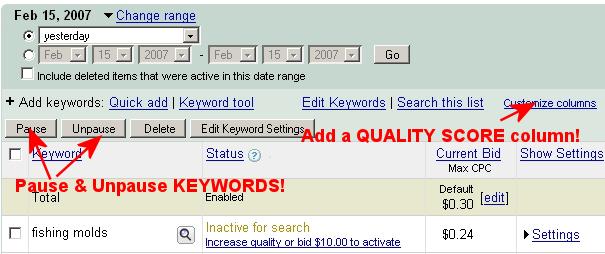
By the end of the day we noticed some very interesting changes in AdWords… Look at the graphic below: Pause / Unpause Keywords (long time in coming, but well worth waiting for AND Add a “Quality Score” column (too bad it’s just great, ok and poor — if you are being asked to bid $10 YOU KNOW IT’S POOR)

Other sites also reported to original issue… SEO Roundtable, Webmasterworld and DigitalPoint.

Google Checkout Icons - An Unfair Advantage?

10:18 am   -   February 16th, 2007

By Jeff Martin

I remember in the 90s when web directories and web rings played a vital role in moving traffic along the web. Web directories often gave you enhancing options to your text listing such as bolding your title, changing your text color and placing my all-time favorite - Hot Icon! the flaming HOT icon next to your listing Hot Icon!. Anything that set your listing apart from the others could really pay off. Google is allowing for this type of distinction by allowing Google Adwords advertisers who offer Google Checkout on their site a colorful icon that displays at the bottom of their ads in the Google search results pages:
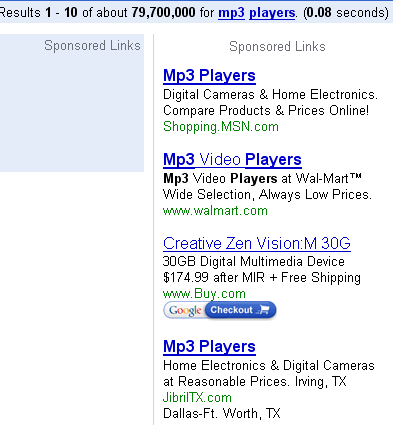
Google SERP Screenshot with Google Checkout Icon

The Google Checkout icons may significantly help draw attention to Adwords ads that have the icon while at the same time become a problem for other ads. It could be argued that the icons offer an unfair advantage to ads with icons as:

  • The icon takes up a line of text so that the more ads with icons there are on the right the less ad space there is for other ads. It’s possible that an ad that would normally show just above the fold on the right side may not show up without scrolling depending on the number of these icons.
  • They may have a better chance of drawing the eye of users and the click away from advertisers paying more and/or with better quality scores.

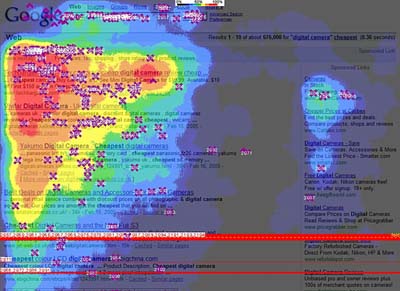
This is especially true in Google search results page real estate where it’s cheaper to place ads on the right and more towards the bottom of the fold of the page as these ads get less attention typically. Ads in this area with the icons may have more success now. The image below from an eye tracking study by Enquiro illustrates this as the “hotter” the color the more visual attention the real estate receives (the thick red bar towards the bottom represents the typical fold of the page):

Google SERP Eye Tracking

As more data is collected we should know more about the ramifications of the Google Checkout icon for those who have it as well as for those who don’t.

Could A Caveman Use Your Web Site?

3:09 pm   -   February 14th, 2007

By Larisa Thomason

My family loves the new GEICO Car Insurance commercials where the hapless caveman defends his species against ignorant assumptions that all cavemen are idiots. Apparently, we aren’t alone. News and commentary about the commercials is all over the Web:

This is great viral marketing, and we’re all envious. But the point of the campaign is something that every Web designer and Web site owner should engrave on their keyboards:

“So easy a caveman can do it!”

Yep. GEICO is making usability their value proposition - at least in this ad campaign. If only every other Web site made the same commitment to ease of use.

Unfortunately, if you start discussing “usability” and “accessibility” with many site owners and designers, their response is less than animated. You can generally count on silence, glassy-eyed stares, and gentle snores of boredom.

Actually, usability is anything but boring. It’s a vital ingredient in customer satisfaction. Review these three scenarios. Chances are, you’ve had similar experiences.

  • You’ve spent hours scouring the Web, and finally found the perfect gift for your hard-to-please significant other. Then you can’t complete the transaction because the shopping cart isn’t compatible with your browser.

    Are you bored?

  • Or what if you’ve forgotten to mail your credit card payment and it’s due right now? You go to the card Web site to pay online, but can’t read the information because the text displays in 8px type.

    Have you accomplished your task?

  • How about this situation? You subscribe to a satellite TV service and get a notice that prices are rising. So you sign into your account to see what service you have now and compare costs. But the Web site doesn’t give you access to that information. All you can do is pay your bill and order movies.
  • Does this site offer what you need?

These situations are a minor irritation for most users, but can be major obstacles to users with physical or cognitive disabilities. People using assistive technologies generally have one way to access information. If the site doesn’t accept that method, the disabled user is just out of luck.

Maybe you think: “Hey, that’s just a few people and I can blow them off.

But think back to those users who were irritated or frustrated. They have options, and one of them is to click straight over to your competitor’s site and breeze through his shopping cart to buy that special gift.

GEICO has the right idea. “Easy to use” isn’t just goal; it’s a requirement for a successful Web site. Good usability by itself can’t make your site a success. However, poor usability - by itself - can make your site a failure.

There are many Web usability resources that cover everything from basic usability and accessibility principles to legal requirements for site owners. Check them out:

Then invite that caveman over and ask him to do a usability test.

PPC/SE Market Share… Who Cares! Let’s Talk Conversions! Google, Yahoo, MSN

5:00 pm   -   February 12th, 2007

by Jim Gilbert

Okay, we’ve all seen numbers published on search engine market share for the big three in numerous ways including PPC market share. Number of searches, search engine revenue, PPC revenue blah.. blah.. blah..

But Wait… What do REAL WORLD Conversions Look Like from an advertiser’s point of view?

This test began when MSN’s AdCenter came about and is as about an accurate comparison I am capable of making (which by the way is very fair and quite accurate). Granted, the exact campaigns cannot be built in all 3 PPC engines, but these campaigns are real and built as closely alike as they can be.

And yes EVERYTHING (well most everthing) has been considered including:

- Conversions in this case are based on online sales of a simple product that sells many, many times per day! (so don’t try the “small sample size” excuse on me here).
- No budget limitations.
- Etc… etc… etc…

No more words… the results

Percent Of Actual Conversions
Google 76%
Yahoo 19%
MSN 5%

Political Campaigns Finally Take Notice Of SEM and Paid Search

8:26 am   -   February 8th, 2007

By Larisa Thomason

It almost seems comic now in 2007. But one of the big election stories in the 2000 campaign was John McCain’s decision to put his Web site address on his yard and rally signs. The Web site 4President.us has a screen shot and an accompanying article.

McCain noted on April 30, 1999 that:

“The Internet provides us with a new and exciting opportunity to communicate directly with voters,” said McCain. “Each of us can now become better informed and more closely involved with candidates and their positions on the issues. Using sites like mine, citizens young and old can find the information they need to make more educated choices about their leaders.”

A prescient statement, but - if anything - Senator McCain underestimated the impact of the Web on political campaigns. Changes have taken place at lightning speed. Here’s a quick timeline:

1996: The Dole/Kemp campaign announces the launch of the first customizable, interactive political Web site.

2000: John McCain puts his Web site address on signs and participates in online chats. The site also includes biographical videos.

2004: Howard Dean becomes the first true, Internet-powered candidate, raising an astonishing amount of cash online, organizing support via Meet-ups, and a chatty campaign blog.

By 2004, the coveted “grassroots support” factor had evolved to “netroots support” and everybody wanted some.

But even as candidates jumped on board with interactive sites, blogs, and custom tools, most completely ignored one of the most critical components of a successful Web site: getting people there in the first place!

Or, as we call it, Search Engine Marketing.

At least, they ignored the whole process until this past 2006 election cycle.

The Rimm Kaufman Group, an online marketing agency, conducted this study of paid search advertising during the 2006 election cycle.

The money quote (emphasis added):

“We conclude that paid political advertising on the search engines is still in its infancy. Note the cost of search advertising is a fraction of the cost of television advertising, yet often has comparable reach.
We anticipate search engine marketing will become increasingly prevalent to the American political process in coming elections. In the 2008 elections, we predict political advertisers will completely fill the paid search spots on the first page of Google search results pages; political advertisers will advertise heavily on Yahoo; political advertisers will use more video; and Democrats will increase spending to match Republicans. “

Some current trends tend to prove them right. Just do a search on Google for different candidate names and you see that not only have most candidates jumped into paid search, they’ve gotten canny about it too.

Republican candidate Mitt Romney is the leader so far. Search on “Rudy Giuliani,” “John McCain,” “Sam Brownback,” or “Tom Tancredo” (all rivals for the GOP nomination) and a link to Mitt Romney’s site appears in the AdWords results section.

In contrast, Bill Richardson, Wesley Clark, and Tom Vilsack are the only Democratic candidates running any paid ads at all - at this time.

That’s a surprise, given the preference of Democrats for news delivered via newspapers, magazines, and the Internet. The NewsCorpse Web site discusses a study of news preferences broken out by political preference published in Editor & Publisher, noting that Democrats preferred written and online news sources:

…breakdown by percentage of Dems vs. Repubs for each type of media:

Red Media:

Preferred by those inclined to vote Republican.

Repub Demo
TV News 87% 83%
News Radio 62% 51%

Blue Media:

Preferred by those inclined to vote Democratic.

Deno Repub
Local Newspaper 78% 70%
National Newspaper 24% 15%
News Magazine 21% 16%
Internet News 43% 38%

So why aren’t the Democratic presidential candidates for 2008 jumping into the fray, and what’s up with those Republicans who also lag behind Mitt Romney?

Maybe they the need the guidance of professional search engine marketers! Too many campaigns are run by political science majors. Not that there’s anything wrong with that - except that not many are technologically literate.

I see this as a fertile field for search engine marketing professionals. Here, I’ve only discussed the declared presidential candidates, but there are numerous state races, local races, and all 435 members of the House of Representatives in contention in 2008.

Think of all those clients!

And remember, in most cases, we’re talking about opportunities in both the primaries and general elections.

In my opinion, most campaigns don’t have the time for a full SEO campaign to work. Some lucky campaigns will benefit from increased link popularity when plugged-in supporters add home page links to their blogs, sig lines, and other Web sites, but that’s for the major, highly visible campaigns.

The real opportunity here is in managing a paid search campaign. Think about the benefits: the campaign gets instant exposure - even when the searcher may be looking up a rival!

Political search engine marketing is potentially a lucrative sideline; it’s also a way for an SEO professional to do some pro bono work for causes that really matter to them personally.

It’s a win/win situation either way.

Keep this opportunity in mind as you consider what sign to put in your yard, what sticker to attach to your car, or where your carefully-considered contribution dollars will go this year.