Earlier this month when I spoke at SMX Advanced on the topic of “Beyond the Usual Link Building”, one of the suggestions I made in the presentation was about how to improve how your listings appear within the search engine results.
There are a lot of people I’ve met who tend to be hyperfocused on whether their pages rank, and don’t spend as much attention on how those pages’ entries appear within the search results pages.
It seems like common sense that if the entry looks like what a user is seeking, they’d be more likely to click upon it. Therefor, if you were to improve your search engine results page entries, you’d also likely improve your click-through rate — increasing your traffic.
Compare these listings on Google for a search for “Seattle indie records shop“:
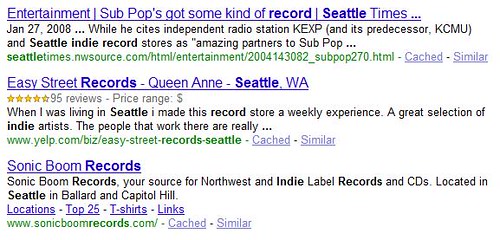
You can see that the star ratings and review on the listing for “Easy Street Records” is slightly more eye-catching if you were a records shop afficianado — the stars and the dollar-sign price range and the easy-to-read sample review text give it an advantage over the listing for the record shop below it. A consumer who is rapidly scanning and clicking to find what they want is going to be more likely to click here.
How much more likely is such a listing to gain clicks? According to Vanessa Fox, Yahoo! has reported a 15% click-through-rate (CTR) increase on similar types of listing treatments! Their results were based upon comparing the CTR of typical search result listings with CTR of listings sporting their special treatments developed through SearchMonkey. The customized listings really stand out from the other listings, drawing the eye and clicks, too.
Yet, before these research results were released, I’d already seen how merely fine-tuning the listing text alone could improve both CTR and rankings. Using savvy methods for forming TITLEs and Meta Descriptions on pages, one can improve keyword relevance, ranking, and click-through-rates.
Now that Google has launched their own type of enhanced listing treatment, dubbed “Rich Snippets“, there’s starting to be even more options for optimizing listings in search results. The first special treatment they’ve enabled are the ones for reviews and ratings, and it seems clear that they intend to launch more, particularly ones related to the use of Microformats, such as hCalendar, hCard, and hProduct.
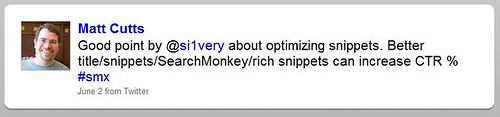
One person at SMX who liked this concept of “optimizing listings” for improved CTR was Matt Cutts, who Tweeted out a mention of it:
While these tactics likely have no direct effect on search engine keyword rankings, I’ve theorized for some time now that they could have an indirect effect upon rank. Google’s frequently-discussed patent for “Information Retrieval Based On Historical Data” includes within its descriptions of ranking methods (“scoring”) the possibility that pages might be ranked according to how often they’re clicked upon when they appear within particular searches. The patent states:
“…scoring the document includes assigning a higher score to the document when the document is selected more often than other documents in the set of search results over a time period…”
Very loosely interpreted, this means that if your page’s listing is clicked upon at a better rate than other pages appearing for the same keyword search, that click-frequency or CTR could actually affect that page’s future rankings for that keyword.
It’s long been controversial as to whether Google implemented many of the methods outlined in various patents like this one, but you already have a good excuse to fine-tune your listings: regardless of theoretical impact on rankings, it could easily improve your click-through rate, improving your site’s qualified traffic!
Quick Tips on Optimizing Listings:
- Title should be brief and state what the page is about, and who you are.
- Meta description should be brief and expand upon what the page is about or how it may be better than others listed for the same keyword search.
- Currently, mentioning deals/discounts/rebates may improve CTR since the economy has pushed people to be more price-conscious.
- Implementing Microformats now on your site for appropriate types of content will likely position you to take advantage of future rollouts of “Rich Snippets” treatements in Google results.
- Building a search application with Yahoo!’s SearchMonkey platform will help you to understand how Google’s developing similar types of listing enhancements.
Good listing engineering is a complex task involving semantic tagging, taxonomic research and development, good copywriting, and SEO knowledge. Don’t make guesses when doing this — use a good expert if you don’t have experience with it.
Optimize your snippets and SERP listings, and improve your CTR and Performance!