Resources For Subjects In My MIMA Summit Session

MIMA SummitDuring my MIMA Summit 2010 conference presentation today, I’m covering a large chunk of information very rapidly. So, I’m providing this list of links to longer articles which more thoroughly cover the subjects touched upon in my presentation for those who might wish to dig in deeper:

Title Tag Optimization

Image Search Optimization

Benefits of Loose Image Licensing for Image SEO

Video Search Optimization

Online Catalog Optimization

RSS Optimization

Local Search Optimization

Local Search Ranking Factors

Local SEO 101: Choosing Local Domain Names

Ranking of Businesses Without Websites

Avoiding Tracking Phone Numbers

Category Names In Local SEO

hCard Microformat for Local SEO

KML & My Maps For Local SEO

Google’s New Image Search & An SEO Hint

As you may be aware, Google recently rolled-out a newer, AJAXified user-interface for their image search which features “infinite” scrolling and automatic pagination. The new UI was rolled-out at the end of July to a subset of users, and they state that more users will receive the new layout in upcoming days.

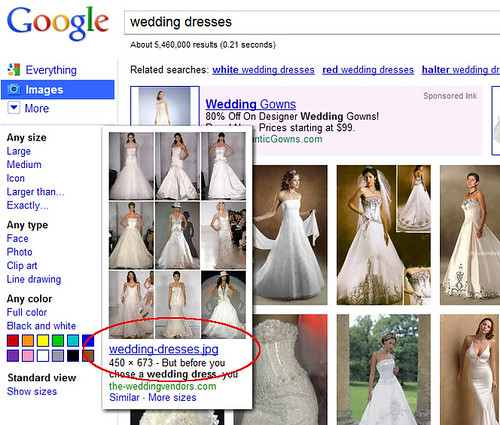
Beyond the items their blog post outlined, I noticed a couple of other things had changed. First, when comparing the new UI versus old, the order of the search results is a little different, indicating that the algorthm mayve been updated. Second, the text associated with the image is different — previously, some visible text from near the image on its native page was shown below the thumbnail in Image SERPs. Now, the new UI displays the image filename instead of a title or a caption.
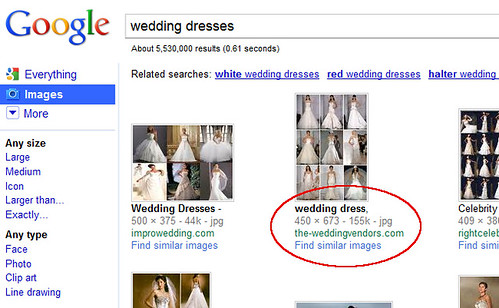

Legacy Google Image Search
Legacy Google Image Search

New Google Image Search UI

New Google Image Search UI


Google has apparently decided that an image’s filename is more important to display to endusers than other text — this is a major paradigm change! Google must’ve decided that the filename is a more important usability or user-experience factor — and Google likes using such factors in their ranking algorithms.

This could mean Continue reading

Appearing & Speaking At SMX East 2010

KeyRelevance at SMX East 2010 Search Marketing Conference

Christine Churchill, President of KeyRelevance, and Chris Silver Smith, Director of Optimization Strategies at KeyRelevance, will both be speaking and moderating sessions at the upcoming SMX East Conference in New York, NY, October 4-6, 2010.

SMX at Javits Center in New York City

Don’t miss this opportunity to us speak on current search marketing techniques and to meet us in-person!

October 4:

October 5:

Let us know if you’ll be attending, and we’ll look for you there!

Exploring Dates On Pages As A Ranking Factor

During the past year, I became a little excited at one of Google’s many enhancements to the presentation of search results, because I suspected it could hint at a possible ranking factor they might’ve introduced. The element in question is a date stamp.

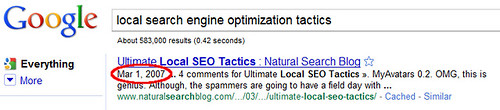
Dates in Google Search Results Page Listing Snippets

You may’ve noticed that in some cases Google will prepend the usual listing snippet text with a date. That change was introduced sometime around late 2008 or early 2009. I noticed the addition of the date with interest, but I became even more interested after I heard Matt Cutts state in a Webmaster Help video that Google considered the date to be helpful to users:

When Google states outright that they consider some element of webpages to be “useful” to searchers, my ears prick up, because Google is so obsessed with Usability that they sometimes use quantifiable elements of user-centered design in their search algorithms, such as their recent introduction of Page Speed as a ranking factor. In this way, Google’s Usability fixation can reveal ranking factors.

I wasn’t alone in twigging to the dates in search snippets — Continue reading