Expanded Broad Match Corrupted Around Aug 20 — Stop Using It!

by Jim Gilbert

Summary of the Issue:

Around August 20, 2007 many clients’ Google AdWords accounts saw their cost/conversion skyrocket — in one particular case we saw it was over 100% increase. It was caused by a corrupted “Expanded Broad Match” algorithm.

What Caused it?

“Expanded broad match” was expanded by Google way too much. AdWords began showing ads for “expanded broad match” terms that were just not relevant to the broad keyword generating them.

What to do:

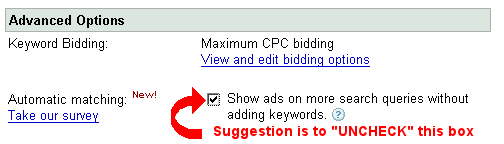
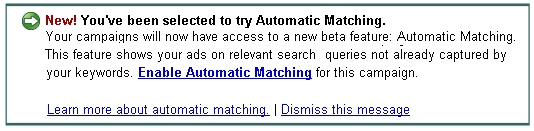
1) Stop using “Broad Match”! If you do use it Google kicks in “Expanded Broad Match” and you can not opt out of the expanded part.

2) Insist to your Google contacts that you be allowed to opt out of expanded broad match!
(We have tried for a couple years, but have made no progress.)

UPDATE: 10/16 — see 10/16 note below


The Rant, Some Interesting Thoughts and the Detail — if you like the fun stuff

The Real Title of this Post should be “Expanded Broad Match – Google’s EPS (Earnings Per Share) Equalizer”

Rarely will you find me crawling all over Google’s AdWords PPC offering. Compared to the alternatives (competition in other words), they have done a technically good job, understand usability, continue to grow their footprint and are somewhat responsive to user (and agency) needs.

However, “crawling” is now in order. Since Google announced their “expanded broad match” it has been a sore spot with all those who understand how it works and what it does. For over 2 years we have begged Google to allow AdWords clients to “opt out” of the “expanded broad match” — broad match as it was originally YES, expanded broad match as it is today NO, NO, NO!

Around mid to late August and into September several very valuable AdWords clients cost/conversion numbers went VERY FAR SOUTH (like in bad & the ugly) — in one case over doubling! Careful investigation revealed that the increase in conversion costs were directly related to a VERY FEW broad match terms.

Even further investigation identified “some” of the new “expanded broad match” terms that had kicked in and destroying the conversion costs. Expanded terms that DO NOT RELATE to the broad term in anything resembling an acceptable manner.

Demands to the usual Google contacts requesting an option to “opt out” to “expanded broad match” were (again) unsuccessful. We provided the documentation and our reps agreed that these documented instances were “kind of far out there”. They even offered to help find more negative keywords to prevent it from happening. In one case we let them try to add effective keywords is and existing list of over 1,200 ones — trust me there was little they could do. See, there is no tool for identifying what Google expands broad keywords to. There used to be, but it conveniently disappeared.

We have great Google Reps, but they can only consult with their superiors on making these types of changes — the reps do not have the power to make something like this happen. Nor do they have “thousands of users” complaining — since their are probably not thousands of users who understand or can detect what is really happening.

Why does Google refuse to allow opt out for “expanded broad match”? The original explanation I received for implementation of “expanded broad match” was to enhance the AdWords user’s experience and provide them a better variety of related ads. Started out innocent enough, but as Google went public and had to answer to the ridiculous quarterly financial demands put on public companies by “Wallstreet” they probably realized that killing “expanded broad match” would have a severely negative impact on AdWords revenue. Furthermore, with continued “Wallstreet” pressure following Google’s first time “missed quarter” Google probably sees this:

My Opinion Only and I will remove it if Google will allow us to opt out of “expanded broad match”.

Not only can they NOT AFFORD to allow opting out of “expanded broad match” — by just loosening the knob they can instantly and dramatically pump revenue up in seconds.

Now it’s time to monitor the “expanded broad match knob”. We have put things in place to detect this “knob turning”. Like last time, wouldn’t it look funny if the knob was loosened only during the mid to late quarter periods?

This is only the beginning — those smart enough to monitor and detect wasted click spend due to unsupportable expansion of terms will at some point do more than just beg or throw fits.

P.S. Relax… I am not a cynic or pessimist — The facts of the analysis support these conclusions (except maybe my final opinions).

UPDATE: 10/16:
Appears the Expanded Broad Match Knob was screwed back in in a good bit. I screamed and hollered and Google backed off — doubtful. What is more likely is that they had pumped revenue all they could for the quarter ending Sep (3Q) and backed off during early 4Q (and Hoping they don’t have to do that ever again?).

Pig Asking Pig How to Eat? Yahoo….

by Jim Gilbert

Rumor has it that new Yahoo executives are running around the trough asking other Yahooers about the direction of the company and what needs to be done. Ain’t that a laugh!

From my experience with the Yahooers I’m allowed to interact with they are part of the problem — not part of the solution.

Many recommendations have been forwared to Yahoo (from little ole me) regarding their PPC systems and to date NOT ONE has ever been implemented. But then, what do I know since I’ve only used PPC systems for years to manage many, many client accounts? A couple of these recommendations were almost guaranteed to put lots of $$$$ in Yahoo’s pockets.

So Yahoo… this is an open challenge to see if your new executives are serious about making improvements and money! Talk to the “right” people — yes, I’m one of them and not that hard to find.

You might even want to keep in mind that at least one high level executive on “Wall Street” values my opinon. That’s kind of funny… Wall Street wants my opinons on Yahoo, but Yahoo doesn’t.

Google AdWords Allows You To Block Ads With IP Exclusion

Spotted at Search Engine Roundtable and worth the read if you manage Google PPC accounts.

Heck, we are already blocking some of those babies as this is being written.

Google just released a new feature for AdWords advertisers. Advertisers can now specify if they do not want their ads to show up for specific IP addresses.

Visit the Search Engine Roundtable post or Google IP Blocking Help for more…

Strange Microsoft Adcenter Update to Terms & Conditions

By Jim Gilbert

Please tell us there will be more specific information on this odd announcement! Calls to the support center don’t appear to help, since the agents don’t seen to know much about it.

The email from Microsoft:
We’re writing to notify you that your Microsoft adCenter Terms and Conditions are updated. The changes take effect on April 30, 2007.

Some of the key adjustments to your Terms and Conditions include:
— “Microsoft may use matching criteria other than keyword searches to display your
advertisements.”
(Huh?)

— “Microsoft may display your advertisements on its network of advertising channels operated
by the Microsoft network of participating websites and other distribution outlets.”
(Huh?)

And you have to love their closing:
“If you do not consent to these revised Terms and Conditions, you may cancel your adCenter program relationship with Microsoft at any time… blah, blah…, blah…”

Google AdWords — Raise My Bid to WHAT? And Then!

by Jim Gilbert

Remember to check the and then part…

On the morning of February 16th (Friday) many adwords advertisers woke up to find a shocker with their Google AdWords accounts.

Improve your Quality Score or Raise your bid to $1.00, $5.00 or $10.00!

Weve seen this before, but not on so many legitimate sites and quality landing pages all at one time before. Google has assured us that this appears to be a technical glitch and one they are working hard to resolve. “Good grief we hope this is an issue”.

However, even after this is fixed, we still expect some fallout even on the most legitimate of sites — the quality knob may have gotten turned just a bit too high!

AND THEN….
By the end of the day we noticed some very interesting changes in AdWords… Look at the graphic below: Pause / Unpause Keywords (long time in coming, but well worth waiting for AND Add a “Quality Score” column (too bad it’s just great, ok and poor — if you are being asked to bid $10 YOU KNOW IT’S POOR)

Other sites also reported to original issue… SEO Roundtable, Webmasterworld and DigitalPoint.

Google Checkout Icons – An Unfair Advantage?

By Jeff Martin

I remember in the 90s when web directories and web rings played a vital role in moving traffic along the web. Web directories often gave you enhancing options to your text listing such as bolding your title, changing your text color and placing my all-time favorite – Hot Icon! the flaming HOT icon next to your listing Hot Icon!. Anything that set your listing apart from the others could really pay off. Google is allowing for this type of distinction by allowing Google Adwords advertisers who offer Google Checkout on their site a colorful icon that displays at the bottom of their ads in the Google search results pages:

Google SERP Screenshot with Google Checkout Icon

The Google Checkout icons may significantly help draw attention to Adwords ads that have the icon while at the same time become a problem for other ads. It could be argued that the icons offer an unfair advantage to ads with icons as:

  • The icon takes up a line of text so that the more ads with icons there are on the right the less ad space there is for other ads. It’s possible that an ad that would normally show just above the fold on the right side may not show up without scrolling depending on the number of these icons.
  • They may have a better chance of drawing the eye of users and the click away from advertisers paying more and/or with better quality scores.

This is especially true in Google search results page real estate where it’s cheaper to place ads on the right and more towards the bottom of the fold of the page as these ads get less attention typically. Ads in this area with the icons may have more success now. The image below from an eye tracking study by Enquiro illustrates this as the “hotter” the color the more visual attention the real estate receives (the thick red bar towards the bottom represents the typical fold of the page):

Google SERP Eye Tracking

As more data is collected we should know more about the ramifications of the Google Checkout icon for those who have it as well as for those who don’t.

PPC/SE Market Share… Who Cares! Let’s Talk Conversions! Google, Yahoo, MSN

by Jim Gilbert

Okay, we’ve all seen numbers published on search engine market share for the big three in numerous ways including PPC market share. Number of searches, search engine revenue, PPC revenue blah.. blah.. blah..

But Wait… What do REAL WORLD Conversions Look Like from an advertiser’s point of view?

This test began when MSN’s AdCenter came about and is as about an accurate comparison I am capable of making (which by the way is very fair and quite accurate). Granted, the exact campaigns cannot be built in all 3 PPC engines, but these campaigns are real and built as closely alike as they can be.

And yes EVERYTHING (well most everthing) has been considered including:

- Conversions in this case are based on online sales of a simple product that sells many, many times per day! (so don’t try the “small sample size” excuse on me here).
- No budget limitations.
- Etc… etc… etc…

No more words… the results

Percent Of Actual Conversions
Google 76%
Yahoo 19%
MSN 5%

Save Time, Money And Increase Pay-Per-Click Profits With Web Analytics

by Jeff Martin

There isn’t anything sexy or exciting about looking closely over your campaigns. However, doing so through web analytics can save you not only time and money but can also lead to increased revenues through your paid search campaigns.

It’s no secret the search engines stockpile data concerning anything you do. You can’t perform searches without them knowing what you searched for (of course) what results or ads you clicked on, how long you stayed at a site and then went back to the results and choose another, how many results pages you combed through, where you are located, etc. Their data is broken down day-by-day, click-by-click.

Yet, for PPC advertisers, despite paying to have visits to their sites, advertisers are not allowed to know the particulars of each user who clicks their ads through any reporting from the search engines. The search engines have been consistently under pressure to share the information you have. Google has said that they desire to be more transparent and more sharing in the future, but time will tell. Because this click-by-click visitor and usage information is not made available, it’s important to review your web analytics closely and frequently.

Web analytics can save you time by:

  • Viewing all user activity and their relevant information, for all PPC networks in one console (in real-time)
  • Running custom reports to filter down to specific variables you want to use or data you only want to see, getting rid of the “noise”
  • Helping spot suspicious activity through customized and automated reports rather than combing through raw data to see if suspicious activity exists

Web analytics can cut costs and save you money by:

  • Ensuring that your ads are only showing for geographic regions you have specified
  • Ensuring that your phrase / exact matching settings are being observed
  • Ensuring that ads are not showing for negative keywords you have specified
  • Ensuring that your ads are not running outside of ad scheduling hours
  • Helping you monitor campaigns for suspicious activity and aiding you in seeking credits

Web analytics can help increase revenues by:

  • Finding new negative keywords to use based on all of the queries that generated clicks
  • Finding new niche and tail keywords to advertise on based on all of the queries that generated clicks

Web analytics allow marketers to spend more time marketing and business owners to spend more time running their business rather than pouring through data.

Google 8am to 8pm Maintenance?

by Jim Gilbert
Read the Original Post below and you will understand why I am congratulating Google.

Contratulations Google and Thank You, Thank You, Thank You…. for finishing the AdWords maintenance on Saturday!

“On January 13, 2007, AdWords system will be unavailable from approximately 1:00 PM to 6:00 PM Eastern Time due to system maintenance. Please note that your campaigns will continue to run normally during this short downtime. We apologize for any inconvenience”.

Original Post
First, many, many people are reporting fairly severe problems with Google AdWords, AdSense and other mechanisms because of this “emergency” maintenance being performed by Google.

Gotta get on my soap box (being from way back when computers began…lol) and ask the obvious questions…

- 12 hours of maintenance in the middle of the work day?

- Did Google go union on us?

- If it was so critical to do this maintenance, maybe (just maybe) some of the non-union Googlers could have come in and worked during the middle of the night! Hey, we seem to have to work 24 hours a day so why can’t they?

UPDATE: They are doing it again!
On January 13, 2007, AdWords system will be unavailable from approximately 10:00 AM to 3:00 PM Pacific Timedue to system maintenance. Please note that your campaigns will continue to run normally during this short downtime. We apologize for any inconvenience.

- I repeat… maybe (just maybe) some of the non-union Googlers could have worked late last night!

More Grumbling about Yahoo’s Panama

Hey even I’m guilty of griping from time to time, so I’ll try to give Yahoo the benefit of the doubt on Panama. After all it is a SIGNIFICANT technological improvement over the old Overture system.

However, it seems as more people get transitioned to the new Panama system the gripe factor keeps rising. Make up your on mind — but do read the other post we have made on this subject and bee sure to keep tabs on the Panama Gripe Thread at Webmaster World.

And remember… we already told you this: Accounts are transitioned with “categories” mapped as “campaigns”. WRONG! For years agencies have been building Yahoo accounts from Google accounts and equating “categories” to “adgroups” — NOT campaigns. Yes the transition is messy!

posted by Jim Gilbert