After Thoughts of SES New York Guy Kawasaki Keynote & His Twitter Use

Guy Kawasaki - SES NYC Keynote March 2009At this year’s SES in New York City the opening day keynote was Guy Kawasaki. Guy presented a lot of stuff about Twitter. Being a man who’s rather well connected, a thought leader in the marketing world and someone who has decent sense of humor, I found myself rather intrigued by this keynote. It was by far the funniest keynote I’ve attended in a long time, and I think humor goes a long way with me being more open to what a speaker is trying to convey.

Guy’s connections allot him a lot of “first cracks” at tools, websites and services that most “Non-A-List” people don’t have access to, so he gets intimately familiar with the marketing aspects some of these tools could be used for. Now with that being said, is every tool presented to him, or pitched to him make it to his list to present at keynotes? Likely not. The tools he did present actually can be used for some genuine marketing and measuring purposes.

I heard a lot of “grumbling” at SES that Guy Kawasaki is a spammer. “If one of us SEO’s told people to use these tools that way, we’d be fried at the stake“, was one cry minus a pitch fork or two. I found myself disagreeing with this line of thought. When you physically have the choice to follow or unfollow him and even the option to block him as well by very simply clicking a button to not see the spam, I find it hard to call what he does with his Twitter account spam. He does come close to the line with his use of TwitterHawk, but if he uses it truly as he showed the audience where he reviews the tweets before they are sent, then, I really don’t see how that is spam. This is using a tool to help market your message in a unique way.

Tweeting isn’t like searching. With search results, scheming websites are made by the thousands to spam the search engine results and as searchers we don’t have the control like you do in Twitter to just block the result and not see it every again (however, technically you can now with Google’s Search Wiki). With search spam you don’t have the option to “unfollow” like you do in Twitter. If you don’t like what Guy’s tweeting, simply go to his profile and click “unfollow” or “block” and what you call “spam” will cease – “walla!”

There are over 95,000 people following Guy Kawasaki. Apparently those people are finding something of value from the information he and his staff tweet out. We as SEO’s may label his tactics “unethical” or “gray”, but I have a hard time even doing that. I also asked the question on my own twitter, “Is Guy Kawasaki a Spammer or just a Marketer using tools in a unique way”. To my surprise, the opinions came back overwhelmingly that he was a savvy marketer.

I also heard a lot of people making such a fuss about Guy Kawasaki “ghost tweeting”. I took a step back and had to honestly ask myself if it was ghost tweeting if the person readily admits on stage he has people tweeting with him in his account, if he puts it on his profile and readily tweets about it. It’s not ghost tweeting, he’s being transparent, he’s been up front about it for a while now. Would I recommend a client setting off to do what Guy’s doing? Most likely not the same way, again the value to the audience dictates how to work the social media strategy.

Then this morning, Tim O’Reilly was surprised because of the New York Times article that included 2 paragraphs about Guy’s “ghost tweeting“. This particular tweet has been retweeted over and over again. Shock, Drama, Outrage! But why? The man has stated for a while he’s had help with his tweeting, he says he does it to an audience at both SES and SxSW, he has it stated on his Twitter account (also states names of who helps him) after asked to amend it by Dave Fleet, and readily admits it in his tweets when asked. I guess people would like him to add “TRGK” on his tweets for “The Real Guy Kawasaki” for the one’s he tweets? What’s the sense in that – if you don’t like what he and his team tweets – unfollow him.

Then there were outcries that Guy’s a “broadcaster”. I’ve been watching his tweet stream closely. The man (and Guy states it is him who responds, not his team) does interact with his audience, he doesn’t just send out link after link. If it was link after link that truly delineated a spam account from a ‘real’ account, wouldn’t CNN’s account then be considered a spammy twitter account? It’s about the perceived value of the content to the audience. Apparently Guy’s content is valuable to his audience because not only are his followers growing, but look how often he’s ReTweeted. In social media its about the value the end user perceives they are getting, if Guy’s figured out how to give his audience what they want through using tools like Twitterhawk and Adjix, more power too him.

Might some of his tactics float around the “grey” area of marketing and spamming? Perhaps, but I keep going back to those nearly 100k followers who not just speak to him but retweet not just his links but what he says to say they obviously don’t mind, obviously they are seeing value in Guy’s “Spam”. Ironic, no? I think this goes to prove a point that “spam” in Social Media it truly is about the value the end user is getting, not the tactic by which they receive it.

Twitter Uses Microformats

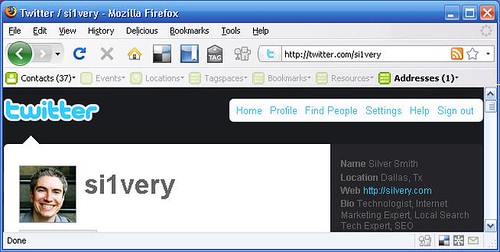
While using Twitter this week, I realized their programmers had incorporated Microformats in the design! I noticed that my Operator Toolbar was responding to the Microformat content in the page, and making it available for me to export.

As you can see from my Twitter profile page, Operator has found Contacts and an Address available in the page. Note the “Contacts” and “Addresses” buttons in the browser toolbar are not grayed out, but are showing as clickable.

The Contacts is returning hCard Microformat info not just for me, but also for all of the 36 twitterers that I follow and whose icons appear on my profile page.

The Address is apparently supposed to be my personal profile’s address data, but it’s not interpreting quite right for me. I think this is because it places the entire Twitterer’s location content in the “adr” value, without breaking the content out into the street address, locality, region and country. Also, the hCard profile attribute isn’t included in the page’s tag.

Still, Twitter’s incorporation of the Microformats in the page code is exciting to me! Why? Well, I’ve written before about how incorporating Microformats can potentially be advantageous for the purposes of Local Search Optimization here and here. Essentially, this can help search engines to more easily interpret the address info on webpages and associate business information with webpages.

Yahoo! has been the fastest at adoption of Microformat content, with Google following close behind. Yahoo’s Search Monkey platform (which allows both Yahoo engineers and all other web developers to create applications which deliver up special webpage listing representations in Yahoo search results) has shown very clearly that Yahoo’s bot has been tooled to particularly harvest Microformat data from webpages in order to make special use of that amongst the various signals they get from sites.

Does Google use Microformats? Yes and no. Google Maps has incorporated Microformats in the display of their search results so that users can access, export and use business and address data easily. However, it’s not yet entirely clear if they spider that same data from local web pages as part of the info they collect in categorizing and ranking pages. Google Maps engineers have told me off the record that they watch all types of data like this, and if there’s a significant number of sites using it, then they will also make use of it in their ranking “secret sauce”. With a high-profile site like Twitter incorporating Microformats, there’s yet more incentive for Google to adjust their data collection algos to incorporate hCard data if they have not already.

In the past week, I wrote an article on how small businesses can and are using Twitter for local marketing. Twitter’s incorporation of Microformats further underscores the value of the service as a component of Local SEO.

Company Branding, Employees & Social Media

brandingAs more and more companies start to dip their toes into the world of Social Media they are faced with the increasing dilemma of how do they brand themselves, who speaks for them and what is the message they want to convey to their target audiences in this medium. This isn’t just a Fortune 500 company dilemma either, the smallest of companies that have employees that are venturing into this medium have to address the same questions, although they have less red tape to cut through to get to their answers.

Inevitably when we start a social media strategy for a client we are faced with the question, “Who Speaks For Us?” on these channels. Is it the CEO? Does he have time? Is it the marketing department, are they just going to try to jam a message down the community’s throat? Should the Public Relations Director handle this or are they going to try and control what people say? Maybe the Search Marketing team is better equipped, or is their main focus going to be about the links? Somewhere there has to be a happy balance right? Most definitely.

Paired with the question of “Who Speaks For Us” comes along the worry about it just being one voice. One single solitary person speaking for the whole organization. Companies can become very leery of this, quite fast if the person speaking becomes popular, or even an overnight sensation. For this reason its important that companies set out policies and guidelines as well as expectations of employees and their work in the social media space for the company. Once employees get a taste of the attention that social media brings, sometimes the though of Personal Branding can come into play and their intentions and actions can enter into murky waters while they are suppose to be doing work for the company. Beth Harte addresses the idea of Personal Branding very well and as background information to this post, I highly recommend taking a moment or two to read this if you are thinking of building a personal brand or are concerned about employees who might.

Stepping into social media, guns blazing, on fire and ready to roll isn’t always the wisest strategy, especially when you already have invested money, time and other resources into branding (both offline and online) already. Ensuring that your logo, your marketing and your message stays true two what you have already established is imperative, stepping out into social media with a new logo for every employee working on your social media strategy can be damaging to your established work and confusing to your audience. This is why having a plan mapped out for all scenarios, especially when those people you’ve entrusted to build your social media presence decide to leave the company, is essential. You’ve spent a lot of time an resources on building your brand, letting it walk out the door with a employee could be a huge mistake!

zappos_logoDifferent situations require different strategies. Take for example Zappos and their use of the social media tool, Twitter. Zappos employees are encouraged to use Twitter and other Twitter users can identify a Zappos employee by the “Zappos” in their Twitter name. There’s Zappos who’s Tony the CEO, Zappos_Alfred the COO, Zappos_Tid who’s head of the training & call center and even the Zappos_Lynn who’s “now working and playing at Zappos.com“. For Zappos and their adaption of Twitter into the rank and file employees to help promote the company through this form of social media, it’s become a rather important branding piece for them and they’ve formulated a strategy around it.

So before you set out on your adventure in social media, stop first and grab a map! If there’s not a map handy, then ask for directions. I know a bit metophorical, but this is a strange new world in social media, a lot of mistakes have been made by companies who just “jumped in”. However, there’s a lot of great successes by companies who just took to stop and look at their strategies and how to integrate their company branding into the social media plan when they are engaging their customers.

Twitter Etiquette – Egos verses Community

twitter-logoI was an early adopter of Twitter, back in the early months of 2007 when it was easy to manage friends, followers, conversations and relationships on the medium. A lot has changed in these two years. From constantly seeing the fail whale, to briefly flirting with plurk, to coming back to twitter with a slew of new applications that enhanced its use, I admit, Twitter has won me over.

That being said, somewhere along the line I feel that people have lost site of what Twitter was really about. Community, engagement, conversation, all in 140 characters. At first it seemed silly – ‘I could never use Twitter, it’s stupid’ was heard a thousand times, but as it was became more of a viable communication tool and companies were engaging in unique ways with their audiences on this medium, something has changed — it’s gone main stream. You scoff? I know it’s reached the main stream when my mother has a Twitter account.

As I stated before, somewhere along the way to the jump to mainstream something seems to be lost in Twitter. There seems to be a growing lack of etiquette as this Web 2.0 tool reaches the main stream. As with any tool that becomes popular, eventually someone tries to monetize it for their own gain through spammy techniques. To a degree it dampens the spirit of what Twitter was originally all about. Of course I realize this happens everywhere, no fear, I’m not naive! The other part of the lack of etiquette part on the rise is the “Ego”. It’s all about how many followers you have compared to who you are following, are you contributing to the conversation or just ranting about yourself, or do you just constantly link to your own blog instead of steering others to other great pieces by bloggers your followers never heard about?

Auto DM’s (Direct Messages)

If there’s one thing that will get me to unfollow someone quicker than sending me porn tweets, its an Auto DM (Direct Message) that “promotes” some other site, profile, white paper, affiliate site or anything else people want to try and get me to click through on. This folks, is Spam. Just because I followed you, it does not give you the permission to SPAM me on Twitter, it just pisses me off and makes me hit the unfollow button. I won’t go into a whole debate about Automatic Direct Messages, Christine Cavalier (fellow Philly gal) has an excellent post on Auto DM’s that is well worth the read, as does Chris Brogan.

I find the “click this” mentality in Auto DM’s to be just total, absolute junk. If you’d really like to get me to read something, talk to me first and then ask me to read it, or become your friend on FaceBook. I don’t have as much of an issue with Auto DM’s that just say “Hey thanks for following me!” without the links, still its lacking the “community” feel, but at least you aren’t spamming me with junk links.

“Tweeters” Who’s Tweet Streams are Just Links

Unless your Twitter account is a blog or a newsfeed (like ESPN, etc.) and it’s specifically transparent that that is the sole purpose of the twitter account, tweeting nothing but links just reeks of spam. I check out each follower email I get to see if the person is someone who’s conversation I’d like to follow. If you’re twitter stream is one tweet after another of tinyurl’s and no conversations, I won’t follow you. It’s likely no one else will either if they are serious about using Twitter to communicate and not really a broadcast channel. Now that being said, there are some twitterers who like getting their news updates this way – and they opt into that. But if you are just a person or just a company pimping your affiliate links, the love affair with your followers likely won’t last long. Twitter is about conversing and engaging, how can you have a conversation if all you do is send out links? It looks like what it is, just Spam.

Not Sharing The Love

This is one of the places where “Ego” comes into the picture. Are you out there sharing the love? Twitter is no different than a blog when it comes to this area. Sharing your knowledge, sharing things you come across, retweeting others tweets, that’s all a form of “sharing the love” and other tweeters really do appreciate it. One of the people I admire the most, who does this so well is Connie Reece, at least a few times a day you see retweets, links to other blogs, links to other tweeters you should consider following or information about causes or just neat stuff. Connie doesn’t let her ego get in the way, she’s truly involved in the community and cares about it. It’s not about her, or how many followers she has – evident by her 18k+ tweets (that are not Spam!).

twitter-no-convos-2

Are You a Lurker/Stalker?

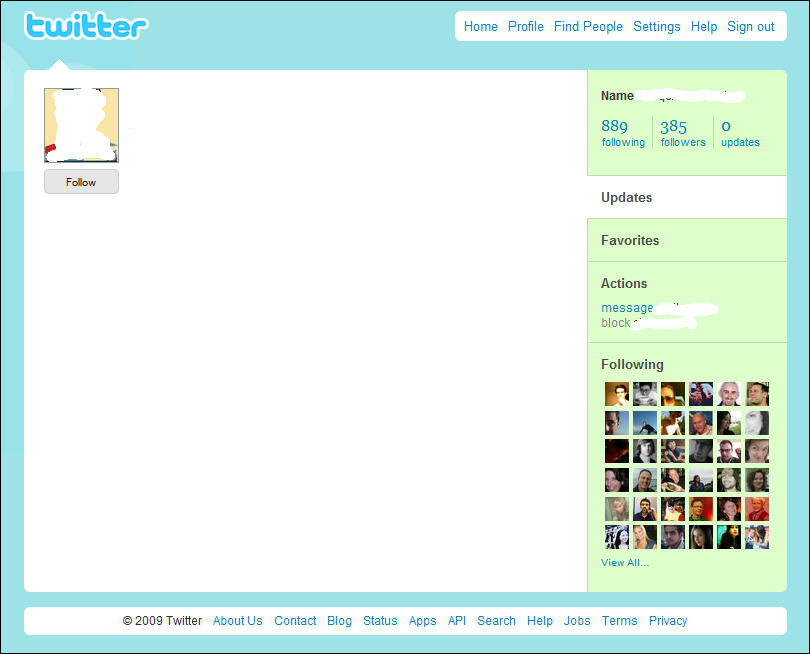
All too often lately, I come across followers who have nothing on their profiles. No tweets! They follow lots of people, and they actually have some followers back. Why would you follow someone who hasn’t put up one tweet? I find this a little disturbing, almost a little stalkerish, which is why I won’t follow someone unless they’ve at least demonstrated they want to at least try Twitter. Why go through even putting up a bio or a specialized Twitter background if you aren’t going to participate? It just seems a bit bizarre to me. It doesn’t take much to get involved, you just type your 140 character message into the box and press “send”, “Hello World” is just 11, it’s not hard, honest!

Follow, Unfollow, Follow, Unfollow….

Unfortunately I cannot be on Twitter 24/7/365. Work for my clients, family time and even the occasional down time take priority over me getting to follow back those who are following me. I try to be pretty good about following back – usually within 3-5 days. What I found rather unnerving is Twitter folks who use the Follow/Unfollow as an attention getter, or that they unfollow you 24-48 hours after that follow message goes out. I’m not alone here either! At South By South West, that was one of the biggest complaints I heard over and over again. Theses “attention” seekers will follow you, then unfollow you, then follow you again to get on the top of your followers list. Adept Twitter users aren’t stupid and they know what you are doing, and guess what – they likely won’t follow you for doing things like this.

Then there comes the people who unfollow you 24 hours later, so they can add more followers to their list. You come back and add them (you don’t know they’ve unfollowed you) and then you get an email again that they’ve followed you. This was another thing that annoys twitter users at South by South West – the people who are just after the big number of followers. Again, that goes back to ego, and Twitter is about community.

So stop and think about how you are using Twitter. Are you so focused on “you” and your ego that you are forgetting what Twitter is about? Are you guilty of one of the above? It’s not too late to change your ways – the other great thing about the Twitter community is if you say “oops i screwed up”, they are very forgiving! 🙂

Doctors, Lawyers, Indian Chiefs – Gag Orders in Social Media

doctors-stethescopeI came across an article in USA Today a few days ago about how some doctors are now requiring patients to sign waivers. Waivers are nothing new, but these types of waivers are. These waivers basically are just “Gag Orders” barring patients from posting negative comments online about the doctor or the practice. What’s probably even more appalling is that there’s a man who has made a business of helping doctors monitor and prevent online criticism by implementing and following through on these waivers.

I’m lead to posing this question: “What makes doctors any different from contractors, restaurant owners, hotel owners or plumbers?

All businesses that service individuals have to learn to deal with negative feedback, especially in today’s world of Yelp, Twitter and YouTube. You don’t deal with it by issuing “Gag Orders” before you render services, its just not how businesses operate. Customers have a right to their opinion whether they spread that opinion online or offline, inevitably there will be disagreement, disapproval and negative feedback in some form. How you deal with it speaks volumes to how your business will survive in today’s economic environment.

I believe I’m awestruck by the arrogance and audacity of these doctor’s who are going the route of the “waiver”. I’m sorry, if your bedside manner sucks, I’m going to speak about it. If you’re office always runs perpetually late on its appointments, I’ll warn my friends before giving the recommendation. If you screw up and leave a sponge in me during my operation and never apologized or showed any remorse, guaranteed I’m going to talk about it. If you treat me like the reasonably intelligent human being I am, with respect and professionalism and answer my questions, I’m also going to speak about it and recommend you. It’s no different than if a plumber screws up the hot and cold water pipes for my shower, and refuses to fix it – I’m going to talk about and want to share my experience with others.

I am the consumer. I have a voice. I have power. I have control. And with the power of the internet – I can share.

So what should these doctors’ be doing? Well first off, if you feel the need for a waiver, maybe you should step back and take a look at how your treat your patients. Second, instead of being offended by the negative criticism, perhaps you should listen to these experiences that they are sharing. A great example of this comes from Charlene Li’s book, Groundswell. Memorial Sloan-Keating in New York started listening via social media about what their patients experiences were and what they thought about them (as well as other cancer treatment facilities in the NCCN network). One of the biggest take-aways was that it wasn’t the doctor’s experience or the reputation of Memorial Sloan-Keating that they had assumed brought patients there, it was the recommendation of their primary care physician. By listening they understood, and stopped assuming they knew it all.

No matter what business you are in, you can’t stop the negative. The negative will always be there, its just how you handle and embrace the negative that will make the difference. I’ve spoken before about upset customers as opposed to trolls, the trolls are easy to spot. The upset customer represents the opportunity to create an evangelist for you, the best kind of marketing money cannot buy. If you want to create these evangelists, you don’t do it by forcing them to sign waivers, you first start by listening and then communicating.

Postscript: thanks to Simon Heseltine for this bit about Lawyers trying the same route as the doctors

Online Video Marketing

Did you know that the 2nd largest search engine is no longer Yahoo? That’s right, people are using YouTube to conduct searches more than Yahoo. That being said, do you have an online video marketing strategy?

Gone are the days where making commercials cost millions of dollars, not just in production costs but in air time as well. Welcome to the revolution of social media and web 2.0 technologies. You don’t need a high end camera anymore, you don’t need uber expensive software either. What you do need is a strategy and some congruent follow through. Without those, just throwing up a video will allow you to flounder or even fail.

Online video is now becoming more about strategic marketing than ever before. Without first thinking about “what’s in it for the audience” first, anything you set off to do will likely get a chilly reception, because you are thinking about it from your own perspective. As with anything these days, understanding that people really hate marketing being shoved down their throats, making your video piece be more about what the end user wants is more important now than ever.

While the subject of your video may be the most important thing, there are other aspects companies need to take into consideration when they look at an online video marketing strategy. Making sure your identity, your marketing measures and your branding are congruent with not just on your print media or on your website, but across all your marketing channels is imperative. What I’m talking about here is avatars, colors, skins and graphics. Companies pour thousands if not millions into these efforts, its their identity, its how people recognize them. A lot of times companies forget to carry this over into all the aspects of online marketing, especially video, and they miss out on big opportunities when they do. In the video below I talk to Greg Jarboe about this at SES London this year.

YouTube by all means is the giant in this space, but its got such a broad user base. Reaching that target market you are really trying to get to engage with your company or brand, can be a pretty tall task when you are dealing with millions of searchers a day. This is where knowing where your audience hangs out becomes vitally important because of all the niche video sharing site out there. Research into this area can really pay off. Sometimes if a video goes hot on one of these sites, it can have a ripple effect into other video sharing sites, even YouTube.

Big companies do not corner the market on this online video marketing world either. Small business with just a flip camera and some simple video editing software can create compelling and engaging videos that can be marketing boons for their businesses. Small business can that produce commercials that can cost less than $100 can hit very targeted markets can be extremely effective. Think about a weekly “specials” video for a restaurant, seeing the food being prepared and then served hot & fresh is more compelling than just a staged photo of a plate with food on it. Attach that to your local profiles and you give people more reason to come to your establishment!

So if you haven’t thought about online video marketing yet, perhaps you should take a second look. This is becoming one of the fastest growing marketing mediums out there, and if you don’t have a strategy to plan and track it right you could loose out!

Markting Via Twitter Is All About Community Engagement

My new article on some ideas on how to “Harness the Power of Twitter for Local Marketing” just pubbed this morning at Search Engine Land. In it, I describe how a number of small and large local businesses are using Twitter, and I provide a small handful of ideas as to how to do it.

Make no mistake, though – the basic foundation of marketing through Twitter is all about “audience engagement” or “community engagement”. Twitter is a communication medium, a micro-blogging platform, a community forum. Micro-communities and macro-communities are grouping up on it rapidly so that people with common interests can easily ask each other brief questions and get back quick answers. Also, people are using it to keep up-to-date with one another in something far closer to real-time as well.

From my perspective, the most effective business uses of Twitter are where companies are providing snippet information of direct interest to their communities, and responding to questions from their stakeholders and customers. Whole Foods and Marriott International are two of these companies which are demonstrating that they “get it”, and are providing compelling interaction through their Tweets.

For many locally-oriented businesses, Twitter is a really good opportunity to gather together a community of interested current and future customers. To do this, one must respect the time and patience of the audience — don’t waste people’s time by too much inane chatter. Also, to build an audience rapidly, consider giving away some really great rebates or freebies. For instance, my coworker Li Evans just “retweeted” (“forwarded”) this offer from Maggiano’s Restaurants to her list of followers this morning:

Li Evans retweets a Maggianos Offer

This sort of discount offer is highly compelling. I took the offer, began following Maggianos, and forwarded the offer to my list of Twitter followers as well. This sort of Twitter use is very powerful! Notice how it’s viral: it encourages people to distribute the offer out to their friends, who send it to their friends, who… you get the picture!

The Twitter phenomenon is growing very rapidly since the service launched only a couple of years back. Savvy marketers will learn how to leverage the potential, but only if they understand the basic foundation of community engagement.

Experimenting in Social Media Can Be Dangerous to Your Brand

Experimenting in social media and web 2.0 can be a really fun thing to do. That is if you are an individual working on testing out some theories, or a small company that is nimble enough to adjust, make quick changes and adapt. Where experimenting with social media crosses the line of fun into dangerous territory is with brands who think that it’s the newest, hippest, greatest “thing” they should be doing, “just because”.

That “Just Because” reasoning is probably the most dangerous reason out there.

  • Just because the competition is out there doing it
  • Just because there’s lots of people on twitter
  • Just because my kids have a MySpace page
  • Just because CNN or Time Magazine mentions it

Those are just a few of the “Just Because” reasons you hear. These are really dangerous reasons to start “playing” with social media, especially if you have never ventured into the area before. There are key things you need to be prepared for if you enter into this space, one thing is that it takes time. So many companies are coming into this space thinking if they slap up a Twitter stream, or a Facebook page, that’s social media. Sorry to burst the bubble here, that’s as far from social media as a company can get. That’s just more of the same old advertising consumers are sick of.

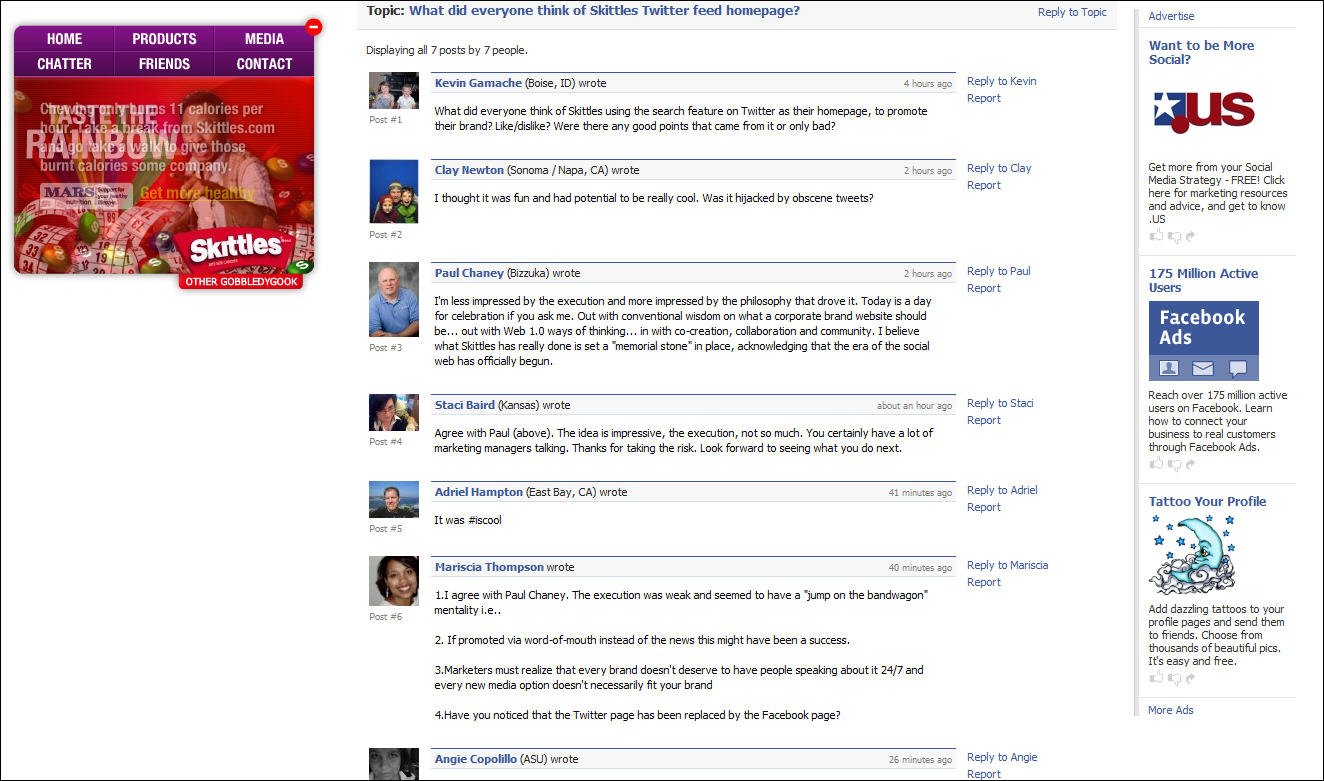
Skittle's Facebook HomepageI wrote about Skittles not “getting it” with their Twitter Stream & social media when it launched on Monday. Word comes from Media Post that they pulled their Twitter campaign. Now Skittles is showing a facebook page. Again, this isn’t social media. These are just flashy billboards, ones that after a while can even hurt the Skittles brand.

update: @CharleneLi has said that Skittles was going to change out their homepage all along. Regardless of that I’m still standing by the fact that this isn’t “real social media”

Why aren’t these social media? Skittles is using social media aren’t they? The word here is using. In social media, you need to actively engage, not utilize it as an outlet like Skittles is. Did Skittles engage in conversation on Twitter? No, heck they don’t even own the @Skittle twitter account that people were trying to talk to them through. Are they engaging on Facebook? Nope, it’s other people starting conversations (see screen capture to the right, click for larger view). Skittles uploaded pictures, but isn’t starting discussions, or engaging in them, not even the good ones. Someone had commented on my post about Skittles on Monday that “did I see they were doing Facebook, Flickr, YouTube and Wikipedia?“. Yes, I did know, but here again, they aren’t engaging the community. For example at the time I write this post, the YouTube channel as 24 subscribers, and they’ve only watched 19 videos, favorited 1, not responded to any comments, and it doesn’t look like they’ve made any friends. How is that being social? (please also note: their “use” of Flickr is just a stream of photos on flickr tagged “skittles”, like Twitter, prime for spamming)

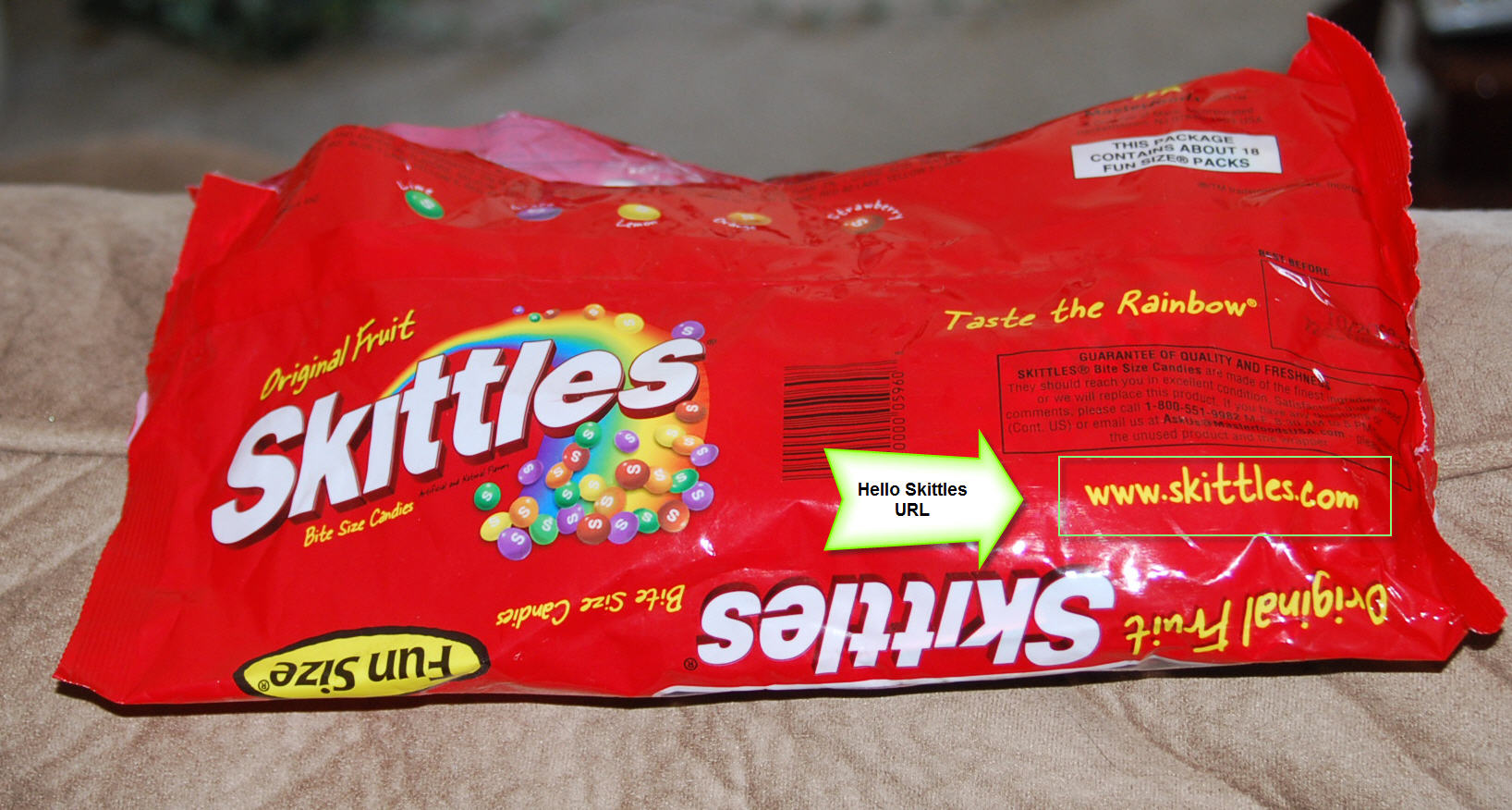
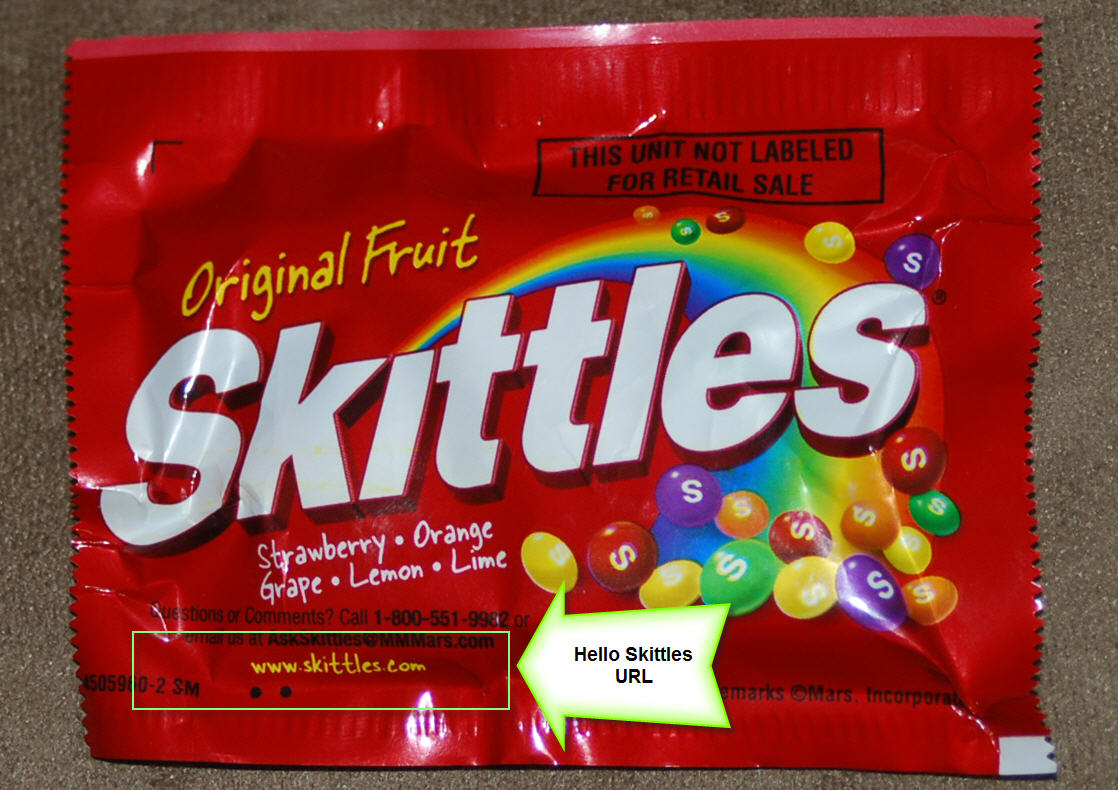
Experimenting with Social Media can come at a cost, too, especially when you are dabbling with something that is totally out of the spectrum of your target market. Lets take for example Skittles again. Skittles is a candy. Who is candy marketed too? Kids and perhaps teens. Now with that in mind, what do you think is on all the packaging for Skittles? Their URL (see the photos below I took of a Halloween style candy handout and the bag those came in)! What do you think kids are going to type into their computer if they are eating Skittles as they surf the internet? http://www.Skittles.com. Do you think Skittles.com is going to be stopped by parental filters? Not before Monday it wouldn’t have been. Now, let me pose this question – are these kids and teens using Twitter by the droves? No, they aren’t – you find them on Bebo.

skittles-back-for-fun-sizes  skittles-fun-pack-halloween

So your major demographic is kids, but you are using a social media piece of technology not used by your target demographic, why? Ummm “just because“, it’s cool and it will get us buzz! Will it get more kids or parents to buy your candy. Nope.

What it will do, is insight the spammers, the jokesters, the rather rude people to make a mockery of your brand. It then causes those kids who read your packaging who come to your site because you displayed your URL to see messages like this tweet (please be informed that link is rather offensive), and those kids to ask their parents, “mommy what kind of flavor of Skittles is that?”

See the danger of experimenting with social media, now?