SEM ClubHouse

a Key Relevance blog


Feeds


You Need a Hook to Get Your Press Release Noticed

8:48 am   -   April 30th, 2009

By Liana “Li” Evans

fish_and_hookThere was a time where announcing that you’ve hired a new employee was enough to get a mention in the newspaper. Announce that you launched a new website, it could get the local news station to your office for an interview. Back in the day, those were hooks that could catch a reporter’s attention enough to bring them in and have them talk to you more about you and your company or organization. “Back in the day” was 2003 when I’d do public relations for my clients and getting the press interested with them was part of what I did with my web design firm. Still I always need a hook, not just “We Launched a New Website”, but something more.

Today, it’s not just the press you need to bring in, its your audience. Clients, fans, evangelists and even detractors are all online all craving for reasons to care (or not care) about what’s going on in your company that matters to them. Just sending out announcements that you’ll be appearing here or there, that your are adding a new product line or you’ve changed the name of something really isn’t enough to get your audience to care ….. unless they were involved or responsible for your actions.

As with creating valuable content for social media, with press releases PR people have to start thinking well beyond “I need to get Buzz”, to “why will our company’s audience care about this information”. It isn’t about that its new, or its got great features, it’s about how the audience finds value in the information you are trying to disseminate. Your audience isn’t just the media or industry “experts” anymore, it’s now your consumer audiences. No longer does your audience see the TV reporter or the newspaper journalist as the preeminent authority. The authorities now are bloggers, forum members, photographers posting their work on Flickr, it’s the people holding a conversation about you & using your brand with a hash tag in front of it on Twitter, and its those people active in a fan group on Facebook. These are the people you need get to care about what your press release is about and they really don’t care if your CEO is a keynote somewhere at an industry conference – unless you are Apple and it’s Steve Jobs at MacWorld.

The hook now becomes “how does this affect my life” or “why should I care”. If you’ve changed something about your company, products or brands after listening to the conversations in social media circles – that’s something your audience will care about. So rather than announces a product launch to the entire media like CNN and the NY Times, look to your audience first. Take the approach “We Listened, We Responded, What Do You Think?” with the bloggers or “community elders”. Give them the scoop first and fashion it in a way that it’s not the “normal spin”, that this is truly about your customers and audience.

At the end of the day, it takes a lot to change the mindset of entrenched PR Agencies, PR Specialists and marketers that there’s been a dramatic change in who people view as authorities. There’s also been a dramatic change in how audiences and consumers consume information and what they care about. Understanding both of those can dramatically increase the exposure of your press release and its success to the right targeted market.

So the next time your PR Agency suggests writing a press release about an internship, a keynote speaking event, or a new website redesign, maybe you should stop and think about your audience. Are they REALLY going to care? Then after you do that, maybe you should rethink who your PR Agency is.

Why Free Photos = Good SEO

11:30 am   -   April 28th, 2009

by Chris Silver Smith

I’ve written articles and spoken at conferences on the subject of using images for search engine optimization for a number of years now, and one concept that many individuals and corporations miss is the idea that looser copyright restrictions can often equate with wider promotional value and greater SEO power.

Many companies are still operating under “Business 1.0″ mindsets in this “Business 2.0″ world, and that failure to adapt is often resulting in very real lost market share potential.

Photographic images are often a type of content that is still sometimes hard to come by. If you have images of subjects that could be of interest to someone out there, then you can leverage this demand to obtain additional links to your sites. And links to your site are still valuable and worthwhile in terms of increasing your chances to rank higher in search results for keywords that are important to you. A greater number and variety of links equals a greater chance to rank higher than your competition.

But, if you’ve slapped all sorts of restricting copyright notices and language to all of your photos, then you’ve caused a real chilling effect in terms of the links you could be getting.

I post a lot of my pictures to the image sharing service, Flickr, and while I often have each photo’s permissions set to display “© All rights reserved”, I have placed a notice on my profile page that I typically allow journalists to use my photos if they will give me a credit line when stories are posted online, and link my name back to my homepage. On images that I think are particularly newsworthy, I’ll even mention these terms in the description below the image.

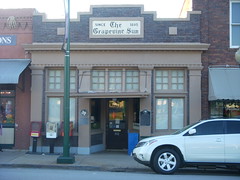
The Grapevine Sun officesJust today, this tactic paid off again it seems that Belo Corporation is closing the small-town newspaper in Grapevine, Texas. The Grapevine Sun has been in operation for something like 114 years, and now it’s closing down like many other newspapers around the country. A journalist contacted me about my photo of the Grapevine Sun office, requesting permission to use it to illustrate their article about the closing. Just as per my terms, they used the logo and linked it back to my site homepage.

This is really a win-win scenario. If I were all uptight about restricting my photos overmuch and forcing people to pay high fees for usage, it would cause all sorts of barriers for distribution for me. It might be one thing if I had some sensational photo of a celebrity doing something fantastic, or a political figure, but for most of my photos the popularity factor just isn’t high enough to warrant pretending I’m the next big photographer of the century.

The journalist got a photo to raise the human-interest feel of their story, and I got a small amount of link promotion value out of my picture. It’s not precisely a “free use” of my image, but it’s close enough from the journalist’s viewpoint, and my providing permission super-rapidly is a sensitive acknowledgement of their story deadline pressure.

News sites and blogs are treated very well in terms of link value by Google’s algorithms, so providing your images in ways that could facilitate bloggers and journalists in finding the images and making use of them can help insure that you could get more inlinks than you otherwise would.

By stating clearly on your photo pages that you’ll allow news and blog stories to use photos in return for a link back to you, you use a very mild and benign form of social engineering to increase the chances that you’ll get some links for your site.

A couple more notes on permissions most companies and PR departments are too restrictive. It’s understandable to fear that someone might use your images to illustrate stories that could be negative about you, but it’s important to keep sight of the big picture: disallowing photos for this use likely will not stop the story from happening, and even links from negative articles can help in your overall rankings. So, it’s better for you to provide the photos for open use regardless of whether you really like the story or not. It’s completely valid to state that the images may be resized but the content within the image cannot be altered.

Even better, using Creative Commons licensing can help encourage more use, and will allow you to specify terms of use that are standard and more easily understood.

In the Business 2.0 world, companies which are not providing easy-to-find and easy-to-use press kits on their corporate websites which include lots of photos of products, services and people in their company well, they’re really behind the times. You too can easily gain valuable inlinks from blogs and newspapers, just as I have.

Why Flogging is a Bad Idea for Companies

6:30 am   -   April 28th, 2009

By Liana “Li” Evans

being-fakeThere’s a lot of definitions that float around about what a “Flog” is. Basically when it comes down to it, Flogs are fake Blogs. How they are fake can be a matter of subjection. However when it comes down to the bottom line, if you are the owner (or being portrayed as the owner by your agency) and you aren’t contributing to the blog itself and the community with which you are trying to speak to with your blog posts, its a Flog. Agencies that set up these types of blogs with or without their client’s knowledge are doing a disservice to their clients and could possibly harm the brands

Take for example the infamous Walmart Flog from 2 1/2 years ago, “Walmarting Across America”. When it was outted it hit the front page of MSNBC back in October of 2006, a firestorm of ethics errupted for both Walmart and for the company who started the Flog, Edelman. A sister of an Edelman employee and her photographer boyfriend were responsible for the posts and photos, problem was they weren’t “real” in terms of the typical person who would RV across America using Walmart as a rest stop.

Granted, it is now over 2 1/2 years later, but people are still pointing to this as the quintessential idea of a flog, but Walmart wasn’t the first to be outted for Flogging. Mazda seems to get that honor for its Flogging attempt back in November of 2004.

Media conglomerate & electronics manufacturer, Sony, has also tried its hand at flogging for retail promotions. Their “All I Want for XMas is a Sony PSP” blog didn’t get more than a few blog posts posted before it was outted for just being a very poor marketing piece put out by fake bloggers. The agency who set this flog up wasn’t even smart enough to put the domain’s registration under Sony or a different name. When this broke, a few weeks after Walmart’s, the ire of the bloggers across the globe who are transparent and truthful was raised.

Agencies that set up blogs without being transparent that it isn’t the real company writing the content, walk a really thin ethical line. Hiring writers to write content exclusively for the blog, that don’t work for the company and having the mindset that “its just content, content will rank”, isn’t the real purpose of a blog. The idea behind a blog is conversation and building communities. If you are just setting up a blog to gain a foothold in the search engine results on Google, Yahoo, or MSN for your client and have no intention of having a discussion about what has been written, essentially this too, is a flog. What agencies and companies who wander down this “fake blog” path tend to forget is that when a flog is outted its just as bad for the Walmart-sized brands as it is for the mom & pop retailer online, it just manifests in different ways.

For Walmart, it was losing the domain “Working Families for Walmart” (because they didn’t register it to start off with), the name under which the RVing Flog was registered to, and it being bought by the union group trying to unionize Walmart workers. For Sony, it was lower sales of the PSP that Christmas. What can it be for other companies? Well readers of blogs, and other bloggers have become increasing savvy over the last 2 years. They can usually spot a fake a mile away. Blogs with no comments, blogs with no readily identifiable authors, blogs with writers who don’t interact, are usually outted in some fashion on another blog. That blog who did the outting, well their audience now has put in their mind “fake”, “untrustworthy” or even a worse label, “Spammer” for the outted blog. Once those labels are applied, usually word of mouth spreads and the once promising “content” blog the agency launched in hopes of gaining a foothold in the search engine results, dies a pretty slow and painful death.

So is building a flog worth the time and effort you might get from a temporary boost in the search engine rankings? Maybe, at first you could be fooled into thinking so. However, once readers and active community participators realize that the blog is consistently about the same topic, the same products and the writers aren’t listening to the community and responding, sure enough, the efforts of the fake blog will be for not.

Google Profiles & Online Reputation Management

7:56 am   -   April 27th, 2009

By Liana “Li” Evans

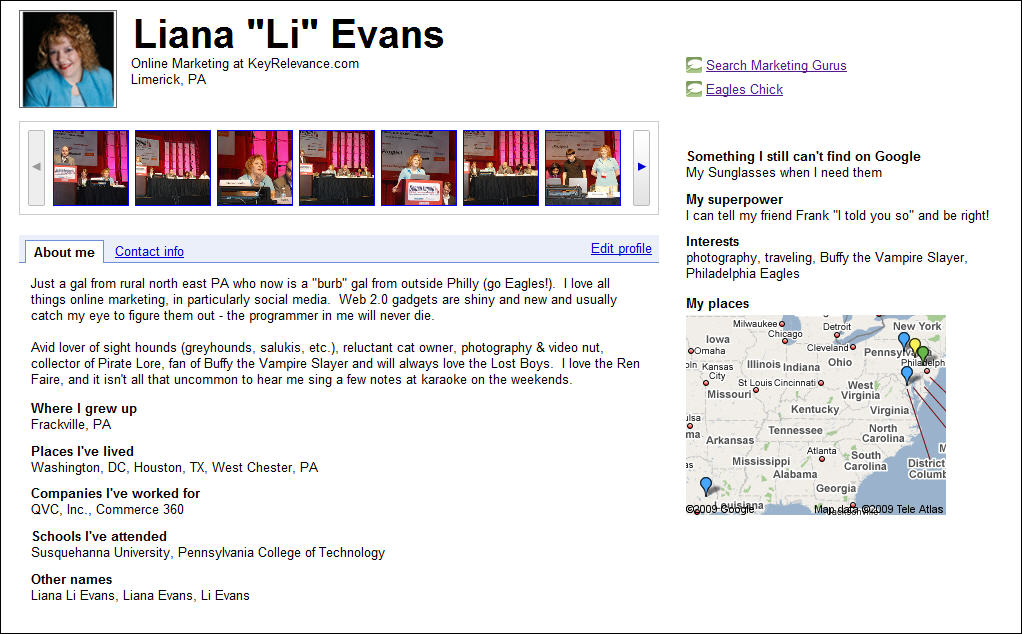
A few weeks ago Google launched “Google Profiles“. Looking at how Google Profiles works, its reminiscent of an online dating site ad minus the creepy old guy that could be my grandfather sending me winks. With that said, Google Profiles can be a powerful tool in online marketing, especially when it comes to online reputation management. Already, Google profiles are showing up in the search engine results. They may not be showing up number 1 for all vanity searches, but they definitely have the power to rank in the top 20 and the potential to rank even higher. Why? Well, Google I guess must really trust itself.

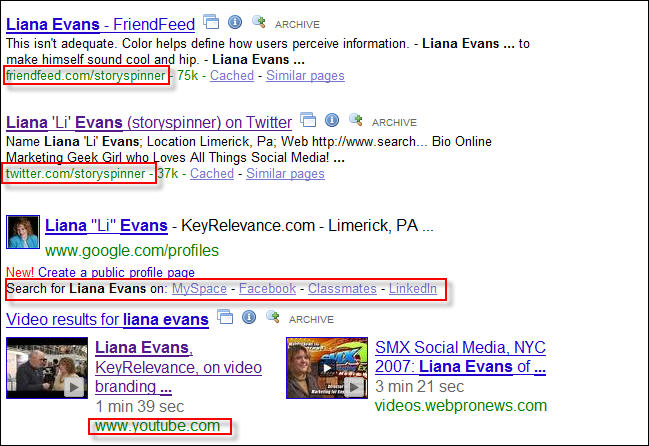
I created a Google profile early last week. This morning I decided to test and see how it was affecting searches for “Liana Evans”. While not in the top spot for my name, the Google profile is now ranking in the top ten, along with several other profiles and videos from social media sites. So keep that in mind, its not just your profile on Google that has the potential to rank and usurp static websites, its profiles on just about any social site. Take a look at the screen shot below:

The social media profiles and videos I’ve got highlighted in red boxes are all ranking for “Liana Evans” near the bottom of the rankings on the first page of the search engine results for my name. Accept for the power of Google, the other profiles don’t rank “just because”. They rank because they are my more “social” profiles. What that means, is that it’s not just because it’s “Twitter” or it’s “FriendFeed”, I’m actually social in those platforms – I hold conversations, I have “friends”, I comment, I share, I watch other videos than my own, etc., that’s what gives these profiles their ability to rank. They also rank because I make sure they are properly optimized, for “Liana Li Evans”, incorporating both my real and my nick name. While being social is the primary key, you also need to remember how you want people to relate to you in these social settings, and make sure your profiles reflect that.

Now before anyone screams “Google Conspiracy” about Google having all your information from your profile, there’s one thing to remember. You do not have to fill it out completely. In other words, you choose what you want to provide to share in your profile. I don’t share all my contact information, just general information about myself and what I do, and my Flickr photos which are already visible through my public Flickr stream.

If you or your company is actively pursuing reputation management, establishing a Google profile might be a wise step in that campaign effort. If you are monitoring your CEO, CMO or any other prominent names that matter to your company, you should be encouraging them to fill out a Google profile with the information related to your business. There are some sacrifices, you are giving Google a little bit more information about yourself, however, again you choose what information to give. The individual is the primary owner of that Google profile, and can choose what information to share, but as an online marketer you can guide the person how to make sure they are presenting the information in a manner that positively affects the reputation management efforts you are undertaking.

KeyRelevance’s Chris Silver Smith to Present at DFW Marketing Association

8:49 am   -   April 21st, 2009

If you have a company that targets local business, you might want to attend the next Dallas Search Engine Marketing Association (DFWSEM) meeting. On April 22, 2009, Chris Silver Smith will be presenting tips on optimizing websites for local search results to the members of the DFW search community in North Texas.

Chris Silver Smith, Director of Optimization for KeyRelevance, will cover the basic elements of optimizing websites to be found in local search results, along with a select few advanced local optimization techniques.

This presentation will be of interest to companies and marketers who provide natural search optimization to large and small businesses which have geographic, location-specific presence.
“Chris is one of the industry thought-leaders on local search optimization,” says Tony Wright, president of the DFW Search Marketing Association. Tony continues, “We are excited that he will be covering a very important part of search engine optimization – local search.”

According to a recent study by comScore, the surge in annual growth of local search has far outpaced growth of overall web search.

“The study found that local search — the practice of using online search tools to find local businesses, products, or services — grew 58 percent in 2008, reaching an annual total of 15.7 billion searches. By comparison, overall U.S. Web core searches grew at a much smaller rate of 21 percent year-over-year, nearing 137 billion searches by the end of 2008. Local searches stand at 12 percent of core searches on the top 5 portals.”

Businesses and search marketing professionals that want to learn more about this fast growing area of search marketing should attend the DFW SEM event on April 22, 2009. To register online, go to http://www.dfwsem.org for more details.

Siloing Your Marketing Can Be a Killer For a Great Online Strategy

12:11 pm   -   April 20th, 2009

By Liana “Li” Evans

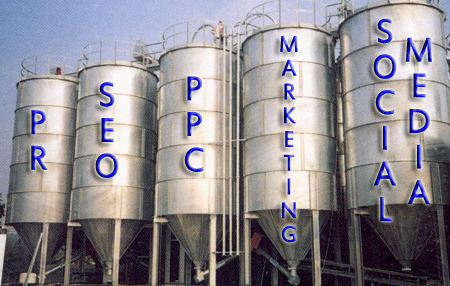
Marketing SilosDo you have a PR Department, a Marketing Department, an SEO Team, a PPC Crew and just kicked off a Social Media Team? For huge companies this is a way of running a business, or they outsources some of these efforts. Medium size companies usually break things out this way too, and smaller businesses tend to lump everything onto 1 or 2 people due to lack of resources to handle it all. While making departments is definitely a great idea, and putting highly specific skill sets together to make a department or team is a wise thing to do, it can be an instant killer to a great online media marketing strategy if each one of these areas are a “silo” that operates in their own vacuum.

So many times I’ve seen this happen with companies. The Public Relations team thinks they own things, the Marketing Team controls some part of a budget and then the online marketing folks really have no control over anything, or have no clue what the PR team has planned event wise. That social media team is too new to even understand they are part of the marketing budget as well. When things like this happen, it only spells one thing – disaster.

By separating out each piece of this marketing puzzle, and putting each into its own silo, a company is doing itself a big disservice. Regardless of how each piece of this puzzle thinks of itself, it’s all part of marketing it doesn’t matter if its offline or online. Each piece understands its particular specialty much better than the others can understand its inner workings. For example you wouldn’t want a PPC person planning your Public Relations events or your PR person bidding on your PPC campaigns. But what you do want is your PR department letting your PPC team know that there’s an event they are planning that they need to get the word out about, or that your PPC team has just found a great niche to work with that they know your PR Team can really use that information to market some events to.

When you start looking at online marketing and what you need to do to be successful in it, you have to pull everyone who has some sort of stake in how your company is perceived into the mix. Marketing and PR Departments need to be part of the planning, not just because “they were there first”, but because they have to be brought into the new media way of thinking about how companies need to reach and converse with audiences. The old way of just “pushing” marketing onto audiences doesn’t work the way it did before the advent of the internet, blogs and social media sites.

Communicating with these areas requires the special talents of a Social Media Champion, having these efforts found requires both a great SEO and PPC team. Knowing what to say and how the company wants to represent itself is part of Marketing’s job but they need to work with Social Media, SEO and PPC that everything is cohesive. Promoting what the company is doing is what PR does best, but these days you can just slap up a press release and think it’s going to go somewhere, that’s where working with the Social Media & SEO teams can come in and make these events shine on the internet.

One of the great keys to creating a successful online strategies is to get all of these teams working together. You need to get each one understanding that they cannot operate in a vacuum anymore. Siloing information in today’s new marketing world isn’t good for your company or the people working on these teams. Each team has to understand that they are very important to one another, that success cannot be obtained unless they understand how each piece of the new marketing puzzle fits together. If you are a company operating in this siloed manner, you might want to stop and rethink your strategy – what’s more important your success online, or feeding the egos of the departments that are siloed? The survival of your company in these tough economic times isn’t going to ride on someone’s ego, its going to ride on successful teamwork!

Can Oprah Sell Twitter to the Mainstream?

5:10 pm   -   April 16th, 2009

By Liana “Li” Evans

Can Oprah sell twitter to the mainstreamOprah can sell cars, she gave away some a few years back, and the maker of the car saw an increase in sales. Oprah can certainly sell books, authors would sell their souls to have the media mogul pick their book for her book club. Oprah also likes Amazon’s Kindle, when she said “my new favorite thing in the world”, sales bumped up. Oprah can even sell an entire nation on the worthiness of one Senator over another to be President of the United States. The woman has influence companies can only dream of having. Now, Twitter doesn’t have to dream any longer.

Tomorrow, according to her Facebook page, Oprah will set foot into a world where most of us marketing, social media and search geeks have called home for the past two years. She’s about to bring with her, an army of loyal and rabid followers who are not exactly technogeeks. Are we ready for this invasion?

Maybe we should be asking Twitter themselves if they are ready for the invasion? After the upgrade two weeks ago, a bounty full of fail whales and missing avatars, I really hope Twitter’s architecture can handle what Oprah’s about to bring them. This is a lot like the “Digg Affect” on unsuspecting sites – your site goes down, and you piss off a lot of loyal customers & lose sales, just for those folks who want to “glance” at it (whatever the it is .. that’s hit the front page of Digg).

It could just be a one day affair. We know most celebrities find these technologies fleeting, and for most celebrities its about the next best thing to be seen doing. So will Oprah keep Tweeting? If she does, it’s likely to have more of an effect on bringing Twitter into mainstream America than anything to date. The woman is a marketing machine, and if her fans see her continuing to Tweet, well then, you can bet within a few months every one of her loyal fans will have a twitter account to connect to her with, and each other. This is probably one of the best examples of how communities can connect, and how Twitter really is about community.

As for Ashton Kutcher being the “King of Twitter”, I have a hard time swallowing that. Oprah’s to have him on the show tomorrow. Of course we all know this is a huge publicity stunt for Ashton Kutcher to beat out CNN to a million followers. I guess Ashton purpose is to show how to use it – how simple it is, to the audience full of women wishing they were Demi Moore.

Twitter is about to hit the mainstream folks, it’s about to become an even bigger topic on marketing agendas because of a one woman marketing machine – Oprah. Are you ready for this change?

Not only that, are you ready to help your Mom understand Twitter? I might have you all beat there, my mom’s already there and even uses Tweetdeck!

URL Shorteners That Frame Websites Hijack Your Content

12:40 pm   -   April 14th, 2009

By Liana “Li” Evans

hijackinghotspotWith the rise of Twitter and it’s limit of 140 characters (250 if you turn off javascript), when it comes to maximizing space to get your message across, every character counts. With that fact in mind URL shorteners are cropping up all over the place. There are some great URL Shortening services, Tweetburner, Bit.Ly, TinyURL and Cli.gs are some great services and actually will track your click throughs.

Then we have another new crop of URL shorteners appearing. These “frame” your content underneath their own branded bar. Digg of course is the biggest well known implementer of this kind of bar. There are several others that do this as well, Ow.Ly and BurnURL are just two. So what’s the big deal, why all the fuss? What could be wrong with what Digg’s doing, after all they are still sending you traffic, right? Well to start with, some of these services have the potential to play havoc with some analytics code. Then there’s the whole “hijacking” of your URL, which is likely one of the things that surfers on the internet are trained to remember, this is essentially hijacking your content for their own benefit – increasing the number of uses of their service.

What’s the difference between what Cli.gs does and what Digg does? Well Cli.gs does a 301 redirect straight to your content when someone shortens your URL, therefore when people click on a shortened URL done by Cli.gs you end up on the content and see the true URL. What Digg does is puts your content under their bar, with their own URL. The visitor NEVER, EVER sees your full URL. Sure some of these allow people to click out of the bar and show you a truncated URL stream to click on, but it’s certainly not the same as someone looking into the address bar for your site’s URL.

What happens when they want to bookmark your site and then entered through Ow.Ly, BurnURL or Digg’s bar? Their shortened URL is what is bookmarked not your site’s URL, doesn’t matter if they are bookmarking to their browser or to a social bookmarking site like Delicious or even StumbleUpon. Again, they are highjacking your content by keeping the framed bar with their URL in the address bar and not 301 redirecting like the other URL shortening sites are!

Sure, some of these URL shorteners that put the frames around can say “oh we make it easy to share with out pull down menu”. Well here’s the thing, people are already “trained” to bookmark or stumble through the bars they have installed in Firefox or IE, that’s where they are going to go first, not to a pull down on a frame. It’s tough to retrain people who’ve been stumbling or bookmarking for well over two years to use some “framed bar” from a new service that isn’t familiar to them, they are going to go with what they trust.

content-hijackThen lets look at the whole “oh I found this I want to blog about it” piece of the marketing and social media puzzle. Someone who finds some great content via one of these framing URL shortening services and isn’t quite tech savvy, pulls the shortened URL from the address bar. Guess what, your site doesn’t get the credit for that link, the shorten URL does. Again, this is basically like hijacking your content.

These URL shorteners make claims that it makes it easier to get your content to be more viral. Personally, in my honest opinion, that’s a load of bunk. It isn’t this tool that makes the content go viral – it’s the perceived value of the content itself that makes something go viral. Then stop and think, what is the sense of your content going viral if the visitors viewing it can’t even see your URL? What is the sense if they themselves can’t share it properly with their own communities like StumbleUpon, Delicious or Magnolia? Your URL is how people remember you, and a lot of sites don’t put their URL in their graphics or headings, they rely that its always going to be in the address bar.

I’ve been having discussions on Twitter about this, and one person claimed I was afraid of them stealing my “Google Juice”. I had to suppress a laugh at that term. I guess because I came into the industry as an SEO, some people will assume I “want my Google Juice” darnit! It’s not about Google Juice at all, at the end of the day this is about who owns the content. The publisher owns the content – not these framed URL shortening services who are hijacking URLs. It’s about it’s perceived value to the visitor and if the visitor perceives its value to be great, shouldn’t the original publisher get that credit, not these framing URL shorteners?

Here are some other great reads on this subject:

Big vs. Small: Which Companies Have An Advantage in Social Media?

8:50 am   -   April 13th, 2009

By Liana “Li” Evans

I’ve seen a lot of discussions over the last few months about what kind of companies do well in social media. Is it the small businesses because they are nimble and can turn things around on a dime? Or is it the large companies because they seem to have the unlimited resources – both money and staff – to pull off the dedication needed to implement a successful social media strategy? I don’t believe there is really a “true” correct answer to this question if you are just comparing the “size” of the company based on number of employees or yearly revenue.

What it comes down to is the dedication of the company to the social media strategy being successful. If the company has a social media champion within its walls, someone who understands that its not about direct correlation of click to purchase, but can still identify realistic objectives to measure for obtaining goals, that is a huge advantage no matter what the size of the company.

Having the Resources Isn’t Enough To Create A Social Media Advantage

Dan Leon - Former Philadelphia Eagles EmployeeWhile having a significant budget available for marketing efforts, or having a team that can dedicate the time does help, at the end of the day, that isn’t necessarily an advantage. If your senior management isn’t on board with the efforts you are trying to push forward, if they do not understand that its really tough to measure successful via click correlation, if they think the social media is just “for kids”, all the resources in the world won’t help you be successful because you lack the buy in from the senior management to attain your goals.

Looking at the other end of the ladder, having too many resources can be just as much of a problem, especially if they are not all on the same page when it comes to your strategy in social media. Making sure all of your resources are filled in on what the company’s message is, how to act in the social media space and what affects their efforts could have on the final outcome of the strategy is vital and key to success you wish to attain. It’s also not just the direct team that is involved with implementing your strategy. If you are a huge company, you have to stop and realize that social media touches everyone within your company who has access to a computer, and not just access to a computer on company time.

Take for example Dan Leon, who use to work for the Philadelphia Eagles. Dan was the front gate manager for the home games at Philadelphia’s Lincoln Financial Field. Dan has nothing to do with marketing, I doubt the marketing team at the NovaCare Center (home base for Philadelphia Eagles operations) even knew Mr. Leon existed. That is until Dan posted something on his Facebook page. Dan, like every other Eagles fan in the Philadelphia area was extremely upset the team let Brian Dawkins go to the Denver Broncos, and posted as such with an update on his Facebook page, complete with expletives. The Philadelphia Eagles fired Mr. Leon for that update, even though he apologized, and removed the offending update from his Facebook news stream. What ensued was a firestorm of anger towards the Philadelphia Eagles and an outpouring of sympathy for Mr. Leon. ESPN, FoxNews, CNN, MSNBC, the local TV news (CBS, NBC, ABC), the local radio stations, the local sports blogs, the local papers, all took this and ran. In fact they are still running with it.

The Philadelphia Eagles had (and still don’t to my knowledge) no social media policies in place, they have never spoken to its employees about how to conduct themselves on these social media sites and most of all – they never got buy in from its staff on the messaging they are trying to convey to the public. What makes the Eagles look even worse is not only does Mr. Leon have a disability, but he also has shown off his certificates for a job well done with the Eagles. Top that off with Brian Dawkins giving Dan Leon his game day tickets when he comes back this year to play at Philadelphia, the Eagles organization just really looks bad all around, despite the fact that Mr. Leon did something out of line. BTW, the Eagles’ resources are upwards of multi-millions of dollars.

Being Nimble Isn’t Enough to Create a Social Media Advantage Either

While small companies can move a lot quicker and be more nimble because there’s a lot less red tape to cut through, it doesn’t mean it creates an advantage for them when it comes to finding success in social media. Sometimes being able to move so quickly can cause companies to not really be able to see how things in social media play out. Then add in the “Bleeding Edge” of technologies in this space, some companies can fall into the trap of the “shiny object syndrome” by implementing new technologies every month because they are so small and nimble enough to be able too. That’s not only not wise and its also not good for your audience. People need time to adept and accept in the social media realm, changing things out as quickly as a new “Google Killer” appears on the internet can really be a detriment to your social media strategy.

Just because your business is small, you are the owner and you love Digg, doesn’t necessarily mean that Digg is the right choice for your business to utilize when it comes to your marketing efforts. There is something to be said about taking a somewhat methodical approach to your strategy, rather than looking at how easily you can implement something. Taking the time to understand that your audience is in Flickr or on a message board and mapping out the right strategy will make you more successful than small enough to be being able to switch gears each month hopping from efforts in Digg, to Facebook, to Plurk and so on.

What Creates the Social Media Advantage?

There’s a lot of factors that create an advantage in social media and it’s not the size of the company’s work force or the revenue they bring in. It’s not actually one thing either, it’s a combination that can create some significant advantages for your company to utilize social media. These are just a few of those components:

  • Openness to Trying a New Approach
  • Having a Social Media Champion
  • Knowing Who Your Demographic Is
  • Understanding What Your Audience is Doing
  • Giving Your Audience Something Valuable
  • Having Buy in From Senior Management
  • Understanding Everyone In Your Company Has a Stake In Social Media
  • Determining Measurable Objectives Before You Jump In

At the end of the day, the discussion of who’s better in social media – Big or Small Companies – is actually not really a good discussion. It’s more about the openness to changes and the ideas of different types of marketing approaches that is really at the root of this discussion. Big, small, red tape, nimbleness, are really moot points, unless you have the buy in from the right areas of your company to implement your strategy. Without a cohesive strategy, no matter what size your company is, most ventures into social media will fail.

Are You Blogging or Doing Social Media for SERPs & Links?

7:52 am   -   April 8th, 2009

By Liana “Li” Evans

linksA lot of companies hear a lot about the social media space. Most of what they hear revolves around Blogs, Digg and Facebook and immediately they think “I have to be there!” Whether its because its the newest fad, their competition is doing it or that they’ve been shown that it can get the SERPs or better yet links, a lot of times companies never stop to look beyond the shiny pretty wrapper of social media to look at what’s really involved when heading down the social media path. At the end of their path, generally it ends in thinking social media has failed them. Why? The major reason is entering into the space for the wrong reason, like acquiring links or getting more footholds in the Search Engine Results Pages (SERPs).

Social Media Requires Resources

Just because a service is free to utilize, as in it costs nothing to sign up for services like WordPress, Blogger, Facebook or Digg, thinking that it is free is a misnomer. Companies need to stop and think about the resources it will cost them in time & effort of their employees to manage a social media strategy. It takes time to grow a powerful account on Digg, if that’s the way you want to go. It takes not only time, but planning, to create a blog that will last. When working on forums, employees need to take time out to respond to messages, threads and pose new questions.

Companies looking to outsource this effort will still have to pay someone to do it, but they could also pay in bigger ways. Having someone, or some company, answer your responses for you, make friends for you, manage your social media profiles for you – can literally turn into a nightmare if it’s found you are not being transparent about it. Anytime you try to automate your social media efforts to be more efficient and less time consuming can also turn you in the direction of facing a Public Relations nightmare with your audience. If an audience feels you aren’t being transparent – upfront about your actions, willing to listen and have a conversation – you’ve lost their trust and its very tough to get it back again.

Social Media Requires Listening

There’s no way around this. In order to understand what your target market wants and how you can provide them value, companies have to take the time, stop and listen to what their audiences are saying and talking about in the social media circles. Coming in and trying to slam marketing or advertising down their throats or just starting to blog about their industry will not get you very much – just a whole lot of crickets chirping. Audiences what to know and feel like they are being heard. That their experiences matter, that what they share with others can some how help even if in a small way. True rewards in the social media spaces aren’t coupons, special discounts or freebies. People feel rewarded when they can help better a product, share a new way to use a service or help create something – feeling like they are part of something is one of the true rewards of social media and in order to give your audience that opportunity, you have to listen to understand what they want to be part of.

Social Media Requires Conversing

Just like with the listening, there’s no way around this either, not if you want to have a successful venture into Social Media. You can’t just lurk in social media. Hiding out in forums, seeing what people are saying about you, then issuing press releases to “correct the wrongs” or launching some other program to “fix what’s misunderstood about our company/product/brand” doesn’t work. A lot of times by just lurking and not getting involved in the conversation, companies can totally misinterpret what the audience is really saying.

By taking the time to speak to the audience and become part of the group, you build a trust that no press release will ever garner you. You build relationships no article in the news media will every let you create. You touch people on a more personal level and they in turn can relate that personal story to all of their friends, and so on. Conversing in the social media realm also puts a more human touch to your message or your marketing efforts. People want to connect to people, not buildings, not marketing pieces of paper or websites, not systems or gadgets (although iPhone users can argue differently) and you connect through holding conversations.

Social Media Requires Providing Value

Just putting up a blog that regurgitates your press releases, articles on your site or some boring piece about another product launch doesn’t provide value to your audience. That’s all about you, and what you perceive value to be. Audience perceive value totally differently. Give them a new or interesting way to use your product or service that they might not have thought about – or better yet, ask one of them to help out with creating the piece about the new way to use the product – now that’s value an audience can relate too. Don’t just write about it either, shoot photos or even a video and create even more value.

If you stop and first think about, “what will my audience find valuable in this content”, rather than “how many Diggs will I get”, your success with your content will turn out a lot better. By focusing on the value you can provide, it puts the focus squarely on your audience and off of you. In social media it’s not at all about you, it’s about the value the customer/audience gets from you that’s the most important factor.

love-what-you-do

Social Media Requires Passion

Considering building a blog because it will get you some “link juice”? Want to get posts out there because they’ll rank for certain long tail key word terms? It may seem like a great idea at first, but unless you’ve got someone who’s passionate about the subject that your blog is about and willing to be social in the community beyond the blog posts, your blog will go no where. Blogging is about sharing your passion with a community for something whether its your life, your hobby, what your company does or the industry your company is in, you have to have someone writing who loves to write about it and wants to talk to others about it. It also extends into other forms of social media. Participating in forums? Having a person passionate about helping people understand your company or product or industry goes a long way in building relationships and trust. If you have someone out there that is just doing it because “its their job” or they were “mandated” to do it, will do you more harm than good.

Outsourcing your blogging can also shine right through, too. If the company you choose to “ghost write” your blog isn’t deeply involved in your industry, a lot of your posts will come off flat, probably overly SEO’d and read like a true marketing piece. Look at successful company blogs like Nuts About Southwest, GM’s FastLane or even Bill Marriott’s mix of podcasting and blogging, all of these are wonderful examples of companies not just blogging about the company but their industry, their employees and customers. Asking you to buy their products, announcing a sale or a new pricing structure from their blog is the furthest thing from their minds, unless its something the audience has asked for.

The Reality of Social Media With Links & SERPs

It takes a lot of time and resources to be successful in social media if your only end goal is getting links or SERPs from it. These are natural byproducts of a truly good social media effort. What you never hear about some of these “overnight successes” is that it takes a lot of man hours creating content that is of value for an audience, as well as being truly social (listening and conversing with your audience). Just because you’ve gone out and bookmarked your blog post, or posted a picture in Flickr or a video in YouTube doesn’t mean you’ll be successful. There’s another entire realm of involvement here that companies need to take into account when planning their social media strategies. None of this really works unless you are being social on some level.

Profiles don’t gain “power” unless they are out socializing with the community – making friends, commenting, rating, adding media, etc. Just because you made a profile in MySpace or a page in Facebook, doesn’t necessarily mean it will take a spot up in the SERPs anymore, 2 years ago, yes, now only if you’ve got an obscure name. The search engines are looking to different signals within the profiles to understand if people are finding these profiles relevant. Sure they still look at links, but now also weighted into the mix are ratings, comments and interaction factors. If you create the “optimized” profile and just let it sit there its not going to do you a whole lot of good.

In the end, you need to plan your social media strategies around other success factors, not how many links you gain or SERP spots your take up. If you plan your strategy around other success factors, the links and SERPs will only naturally come because you efforts were successful in other ways. The links, the SERPs – in social media, they are just icing on the cake to a successful venture in social media.